



























PvP Minefield — 1v1 Minesweeper Duel (2026)
1v1 minesweeper in Telegram: one shared board, three mines, take turns and the first mine loses. Rules, per-pick odds, the first-move maths and the 1.90× pot.

- Top payout
- 1.90× the stake
- Bet tiers
- 5–100
- Mode
- Stars, or 1 Spark a round
- Category
- PvP
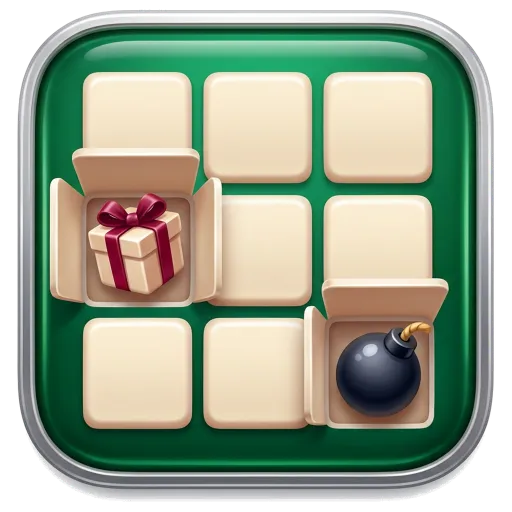
PvP Minefield is 1v1 minesweeper stripped to its nerve: two players, one 5×5 board, three hidden mines, and you take turns opening tiles. A safe tile passes the turn. The first player to open a mine loses, and the other takes the pot — 1.90× their stake. There are no number clues, so it is a game of turn order and luck rather than deduction, and a match is usually over within five picks.
How to play PvP Minefield
- 1Open PvP Minefield in the Games hubLaunch Gift Club inside Telegram, open Games and pick PvP Minefield from the Play with Friends row.
- 2Pick a stake and an opponentStakes are 5, 10, 20, 50 or 100 Stars, a Gram (formerly Toncoin) stake from 0.1 to 10, or 0 in Spark mode. Both players stake the same amount in the same currency. Send a challenge link to a friend in any Telegram chat, or start straight away against the bot, which is labelled as a bot. The bot plays only for Stars or Sparks, so a Gram duel is always against a friend.
- 3Wait for the drawThe board is locked in before your friend joins. A committed draw then decides who opens the first tile.
- 4Take turns opening tilesOn your turn, tap any closed tile. You have 10 seconds. If the tile is safe the turn passes; if the clock runs out, a random closed tile is opened for you.
- 5Avoid the first mineWhoever opens a mine loses on the spot. The winner collects both stakes less a 5% rake — 1.90× their own stake.
 0.1 to 10
PvP Minefield payouts
| Your stake | Pot | Winner collects | Effective multiplier |
|---|---|---|---|
| 5 | 10 | 9 or 10 | 1.90× on average |
| 10 | 20 | 19 | 1.90× |
| 20 | 40 | 38 | 1.90× |
| 50 | 100 | 95 | 1.90× |
| 100 | 200 | 190 | 1.90× |
| 0.1 | 0.2 | 0.19 | 1.90× |
| 0.5 | 1 | 0.95 | 1.90× |
| 1 | 2 | 1.9 | 1.90× |
| 2 | 4 | 3.8 | 1.90× |
| 3 | 6 | 5.7 | 1.90× |
| 5 | 10 | 9.5 | 1.90× |
| 10 | 20 | 19 | 1.90× |
| Pick | Closed tiles | Mine on this pick | Match still running |
|---|---|---|---|
| 1 | 25 | 12.00% | 100% |
| 2 | 24 | 12.50% | 88.00% |
| 3 | 23 | 13.04% | 77.00% |
| 5 | 21 | 14.29% | 57.83% |
| 10 | 16 | 18.75% | 24.35% |
| 15 | 11 | 27.27% | 7.17% |
| 20 | 6 | 50.00% | 0.87% |
| 23 | 3 | 100% | 0.04% |
| Property | Value |
|---|---|
| Grid | 5×5, 25 tiles |
| Mines | 3 |
| Board | One board, shared by both players |
| Turn | One tile, 10 seconds |
| Missed turn | A random closed tile is opened for you |
| Result | First mine loses; no draws |
| First player loses | 53.13% of matches |
| Challenge link | Open for 10 minutes |
| XP, paid match | Equal to the Stars stake, or 90 per GRAM staked, for both players |
| XP, Spark match | 1 for a win, 1 for a loss |
| Gram duels | Against a friend only — the bot never plays for Gram |
PvP Minefield pros and cons
Pros
- Short: half of all matches are over within five picks
- One shared board, so neither player can draw an easier layout
- The same 1.90× at every stake tier, rake included
- Play a specific friend through a challenge link, or the bot straight away for Stars or Sparks
- Accepts Gram as well as Stars
- Both players earn XP in a paid match, win or lose
- Mine layout committed before your opponent joins, and verifiable afterwards
Cons
- Pure chance: no tile choice changes your odds, so there is nothing to get better at
- The 5% rake means the winner collects 1.90×, not the full 2× of the pot
- Flat payout — no ladder, no bigger multiplier for a longer match
- Needs an opponent or the bot; there is no open lobby to join strangers
- Gram duels need a friend: the bot plays only for Stars or Sparks
How a match actually plays
There is one grid and both players are looking at it. You open a tile, and either it is safe — it turns over and the turn passes — or it is a mine and the match is over. Your opponent then does the same on the tiles that are left. Nobody scores anything and nobody cashes out; the match exists only to find out who hits a mine first.
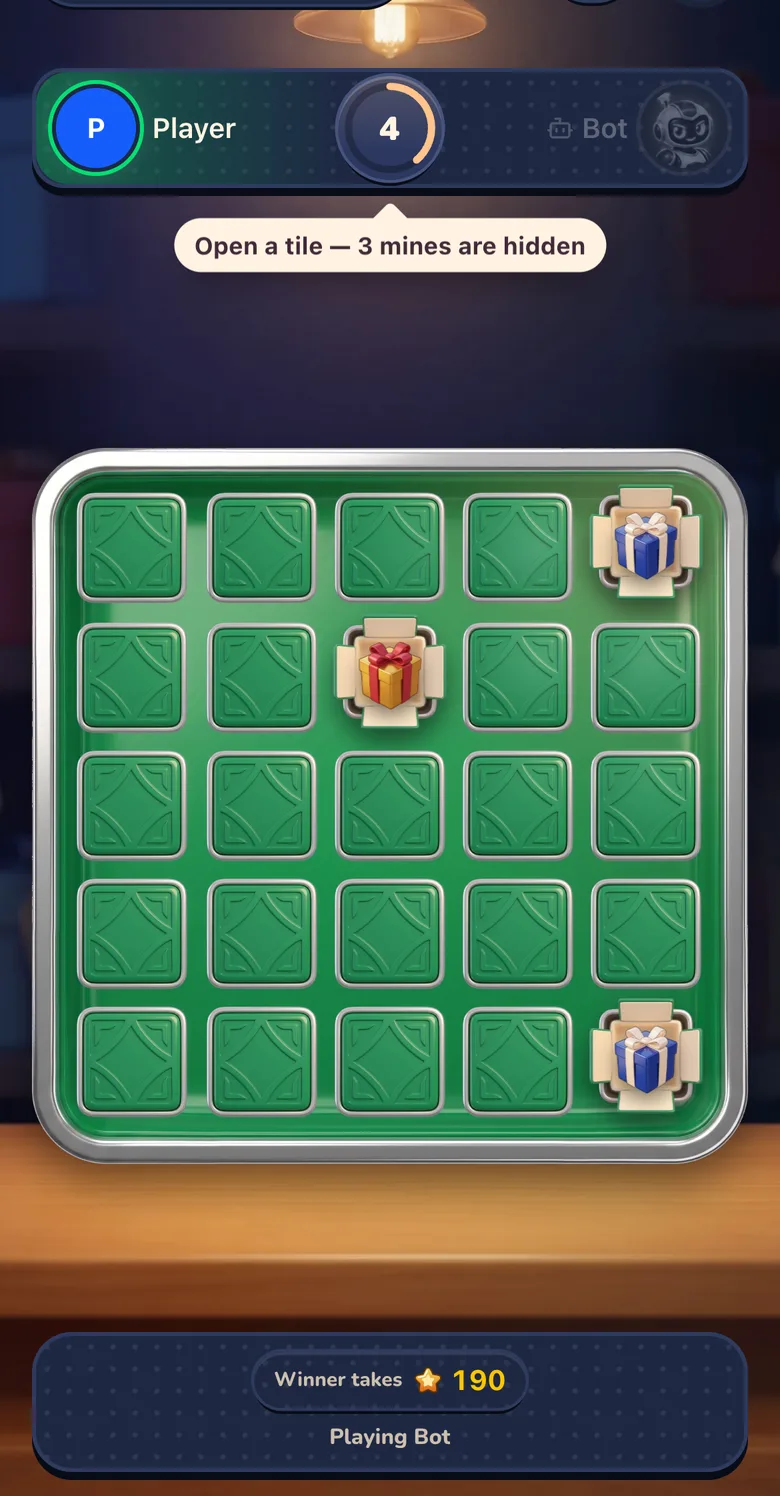
A safe tile shows no number. Unlike classic Minesweeper — and unlike most multiplayer minesweeper games, which race two players through number-clue boards — it tells you nothing about the tiles around it, and the mines stay hidden until the match ends. That single rule is why the game has no strategy: every closed tile is exactly as likely to be a mine as every other.
Your tile choice does not matter — here is the proof
Three mines sit somewhere among 25 tiles. On the first pick, 3 of 25 tiles are mines, so the risk is 12.00% wherever you tap. If it was safe, the next pick faces 3 mines in 24 tiles, 12.50%, and so on. Because a safe tile carries no information, the corner is no safer than the centre and a tile next to one you already opened is no safer than one far away. Patterns, favourite squares and "reading" your opponent's picks all come out at the same number.
The risk per pick climbs as the board empties — 18.75% by pick 10, a coin flip at pick 20 — but very few matches get that far. The first mine is most likely to be found on the very first pick, and three quarters of matches are over by pick 9.
Going first is a small disadvantage, and the draw cancels it
Take every possible placement of three mines, all 2,300 of them, and count who opens the first mine. The first player takes picks 1, 3, 5 and so on, and loses in 1,222 of them: 53.13%. The second player loses the other 46.87%.
That edge would matter if one side always went first. It does not. The opener is decided by the same committed seed that places the mines, so each player is the first mover half the time and the match is an even 50/50 before anyone taps. There is no way to choose to go second.
What the rake leaves you
Two players stake the same amount, the pot is doubled, and 5% goes to the house. The winner collects 1.90× their own stake at every tier — 19 Stars at 10, 190 at 100. At 5 Stars the exact figure is 9.5, settled to 9 or 10 by a rounding draw weighted so the average is exactly 9.5.
Since each match is a fair coin between the two players, winning half your matches returns 95% of what you staked. That is the same margin the solo games carry, taken from the pot instead of built into a payout table. Online games for money goes through why a rake behaves differently from a house edge.
The clock, the bot and the challenge link
- 10 seconds a turn. Let the timer run out and a random closed tile is opened for you. It can be a mine, and there is no grace turn — but since every tile carries the same risk, a random tile is no worse than one you chose.
- Challenge links stay open for 10 minutes. Share one in any chat; your friend taps it and joins at your stake. You can cancel an unanswered challenge and get your stake back. If your friend cannot cover a Stars stake, they can offer to play the match for XP instead; a Gram challenge is played in Gram or not at all.
- The bot is labelled. Playing it starts a match immediately, for Stars or Sparks — it never plays for Gram. It sees the same board you do — closed tiles and nothing else — so it is guessing exactly as blindly.
- Revenge and switch. After a match you can offer a rematch, at the same stake or a new one, or challenge the same opponent to another duel at the same stake.
Provably fair: what is committed, and when
The mine layout and the first-move draw are generated from a server seed whose hash is committed when the challenge is created — before your opponent has even opened the link. When the match ends the seed is revealed, and anyone can check that it hashes to the committed value and produces the same three mines. Provably fair verification walks through the check. The tile opened for a player who misses a turn is picked by the server at that moment, but it lands on the committed layout, so it cannot move a mine.
PvP Minefield, solo Minefield, or another duel?
- Want a bigger multiplier: Solo Minefield. You choose how many mines to face and when to cash out, and the ladder reaches 70.96×. PvP pays a flat 1.90×.
- Want a decision that matters: PvP Ludo. Every roll offers two dice and you use one, so a stronger player wins more often.
- Want the duel that rewards skill most: Sea Battle. Where you fire decides the match, and a hit keeps your turn.
- Want a duel with one repeated choice: PvP Balloon Pump shares one balloon and lets you pump one to three times a turn.
- Want a quick, even bet against a friend: PvP Minefield, or PvP Dice Duel if you would rather roll than tap.
PvP Minefield FAQ
How do you play PvP Minefield?
Two players share one 5×5 board with 3 hidden mines and take turns opening a tile. A safe tile passes the turn; the first player to open a mine loses and the other player takes the pot. Each turn has a 10-second timer.
Is there a strategy for PvP Minefield?
No. A safe tile does not show a number or reveal anything about the tiles around it, so every closed tile is equally likely to be a mine. On the first pick the risk is 12.00% whichever tile you tap. The game is decided by chance, which is also why it pays a flat 1.90× rather than a ladder.
Is it better to go first or second?
Second, slightly. Across all 2,300 possible mine layouts the first player loses 53.13% of matches. You cannot choose, though: the opener is decided by the committed seed, so each player goes first half the time and the match is 50/50 overall.
How much does the winner get in PvP Minefield?
Both stakes less a 5% rake, which is 1.90× the winner's own stake at every tier: 19 Stars on a 10-Star stake, 190 on 100. At 5 Stars the payout is 9.5, settled at 9 or 10 by the rounding draw so it averages the same 1.90×.
What happens if I miss my turn?
After 10 seconds a random closed tile is opened for you. If it is a mine you lose, exactly as if you had tapped it yourself. Every closed tile carries the same risk, so a random pick is no worse than a chosen one.
Can I play PvP Minefield against a friend?
Yes. Create a match, pick a stake and share the challenge link in any Telegram chat. The link stays open for 10 minutes, and you can cancel it for a full refund if nobody joins. If you would rather not wait, the bot plays straight away for Stars or Sparks and is labelled as a bot; a Gram match needs a friend.
Does the loser get anything?
In a paid match both players earn XP, win or lose — equal to the stake in Stars, or 90 XP per GRAM staked; the pot goes to the winner. Spark mode stakes no Stars, costs 1 Spark if you have one, and pays 1 XP to each player, win or lose.
Can I play PvP Minefield for Gram?
Yes, against a friend. PvP Minefield accepts Gram stakes from 0.1 to 10 alongside the 5 to 100 Star tiers. Both players stake the same amount in the same currency, and the winner takes the doubled pot less the 5% rake — 1.90× their stake, floored to the nanoton. The bot plays only for Stars or Sparks, so a Gram duel starts with a challenge link you send a friend.
Play within your limits. Paid rounds cost Telegram Stars or Gram, and every game on Gift Club is built so the house keeps a margin — over enough rounds the maths runs against you, by design. Stars cannot be converted back into money. Treat paid play as entertainment you have budgeted for, set a limit before you start, and play Spark rounds whenever you just want to play. Gift Club is 18+.
 Spark round
Ready to play PvP Minefield?
Opens straight into the game inside Telegram. No download, no signup.
Play PvP MinefieldIn-app Stars can't be redeemed or withdrawn. 18+.