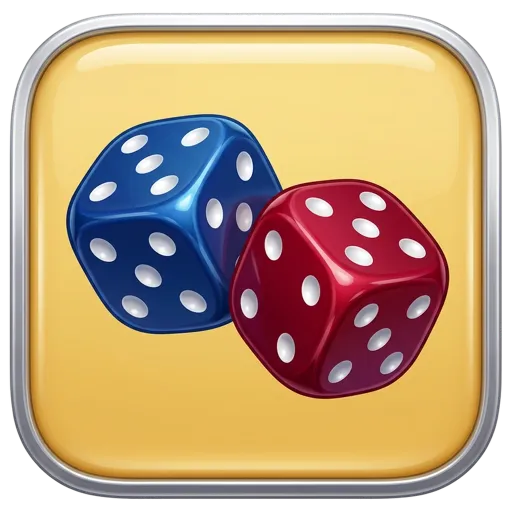





























Roll Over — Over/Under Dice Gambling (2026)
Crypto dice on Telegram, played with Gram or Stars: over/under dice gambling where you set your own win chance, from 1% to 97%. Full threshold table and the traps.

- Top payout
- 95×
- Bet tiers
- 1–100
- Mode
- Stars, or 1 Spark a round
- Category
- Casual
Roll Over is dice gambling where you choose your own odds, and the only game on Gift Club that lets you do that. You set a threshold between 5 and 98, a number from 0 to 99 is rolled, and you win if it lands strictly above your threshold. Because you pick the threshold, you pick the win probability — and the multiplier moves in lockstep, from a 94% chance paying barely over 1× to a 1% chance paying 95×.
How to play Roll Over
- 1Open Roll Over in the Games hubLaunch Gift Club inside Telegram, open Games and pick Roll Over.
- 2Set your stakeSpark mode pays XP. Paid mode accepts 1, 5, 10, 20, 50 or 100 Stars, or a Gram (formerly Toncoin) stake from 0.1 to 10.
- 3Choose your thresholdDrag the slider anywhere from 5 to 98 (a small Stars stake starts higher, see below). The win chance and the multiplier both update live — they are two views of the same choice.
- 4RollA number from 0 to 99 is drawn. You win if it lands strictly above your threshold.
- 5CollectA win pays bet × the multiplier shown before you rolled. Stars wins are capped at 10,000 per round; Gram wins at 1,000.
 0.1 to 10
Roll Over payouts
| Threshold | Win chance | Multiplier | Return on 100 |
|---|---|---|---|
| 2 | 97% | 0.98× | 98 |
| 4 | 95% | 1.00× | 100 |
| 10 | 89% | 1.07× | 107 |
| 25 | 74% | 1.28× | 128 |
| 49 | 50% | 1.90× | 190 |
| 50 | 49% | 1.94× | 194 |
| 60 | 39% | 2.44× | 244 |
| 75 | 24% | 3.96× | 396 |
| 80 | 19% | 5.00× | 500 |
| 90 | 9% | 10.56× | 1,056 |
| 95 | 4% | 23.75× | 2,375 |
| 98 | 1% | 95.00× | 9,500 |
| Currency | Bet tiers | Single-win cap |
|---|---|---|
| Telegram Stars | 1 · 5 · 10 · 20 · 50 · 100 | 10,000 |
| Gram | 0.1 · 0.5 · 1 · 2 · 3 · 5 · 10 | 1,000 |
| Spark mode | 1 Spark — pays XP | — |
Roll Over pros and cons
Pros
- You set the odds yourself — 94 different risk profiles from one screen
- The multiplier is shown before you roll, so nothing about the payout is a surprise
- Covers both extremes: near-certain small returns and 1% shots at 95×
- Accepts Gram as well as Stars
- Provably fair, with the roll committed before you pick a threshold
Cons
- Small Stars stakes can't use the lowest thresholds: a 1-Star stake starts at threshold 52
- The slider makes very high thresholds feel more reachable than 1% odds actually are
- No decisions once you have rolled, and no round-to-round progression
Can you play crypto dice on Telegram?
Yes. Roll Over is the classic crypto dice mechanic, where you pick the win chance and the multiplier is priced to match, and on Gift Club it takes Gram, TON's coin (formerly Toncoin), for stakes from 0.1 to 10, with a single win capped at 1,000. Every roll is provably fair. Gram stays inside the app: deposited Gram and Gram wins can't be withdrawn, they only fund more play. It runs in a Telegram Mini App, so there is no separate crypto casino site to join. How to play with Gram covers the wallet and the deposit. Stake only what you can afford to lose.
The formula, so you can check any threshold yourself
Every multiplier in Roll Over comes from one expression:
multiplier = 95 ÷ (99 − threshold)
Your win chance is (99 − threshold) ÷ 100, because the roll is a whole number from 0 to 99 and you need it strictly above your threshold. Set the threshold to 50 and there are 49 winning numbers, so you win 49% of the time and the multiplier is 95/49 = 1.94×. Set it to 90 and there are 9 winning numbers, so 9% and 10.56×.
Multiply the two together at any threshold and you get the same number every time. That is the house margin, applied uniformly across the whole slider — no threshold is a better bet than any other, which is unusual and worth knowing. What the slider actually controls is variance, not value.
The bottom of the slider is a trap
The lowest thresholds are the one part of the slider to avoid outright. At threshold 2 the multiplier is 95/97 = 0.98×: you win 97 rolls in 100, and every one of those wins returns slightly less than you staked. Threshold 4 pays exactly 1.00×, which is a push dressed up as a win.
This is not a quirk of one setting — it falls straight out of the formula. The house margin is uniform across the slider, and at the very bottom there is not enough headroom above 1× left to fit it. From threshold 5 upward every winning roll returns more than the stake, so that is where the usable range starts.
What is the lowest threshold for each Stars stake?
A Stars win is paid in whole Stars, so every win has to pay at least your stake plus 1 Star. That sets a lowest threshold for each stake: the first one where the stake times the multiplier reaches the stake plus 1. Below it the slider doesn't go. Gram stakes pay to the nanoton and start at threshold 5.
- 1: threshold 52 to 98 (a 2× multiplier or better)
- 5: threshold 20 to 98
- 10: threshold 13 to 98
- 20: threshold 9 to 98
- 50: threshold 6 to 98
- 100: threshold 5 to 98
The 95% return is the same at every stake. A payout that isn't a whole number of Stars is rounded up or down at random, weighted so that it averages out to the exact figure.
The high-threshold trap
The opposite end is subtler. Threshold 98 shows 95×, which is the biggest multiplier in the game outside Plinko's top slot. It wins on 1 roll in 100. A slider that moves smoothly from 97% to 1% makes those endpoints feel like neighbours; they are not. At threshold 95 you should expect roughly 25 losing rolls between wins, and long dry runs are normal rather than unlucky.
Dice strategy: how to actually use the slider
- Long session, small stakes: thresholds in the 10–40 band. Frequent wins at 1.10× to 1.66×, which stretches a balance without ever doing much.
- Coin-flip equivalent: threshold 49 pays 1.90× at a 50% chance — mathematically identical to Coin Flip.
- Chasing a number: 90+ if you have decided the stake is spent. Set the threshold, set the round count, and stop at both.
- Read the top end honestly. 95× at threshold 98 wins on 1 roll in 100.
Is Roll Over provably fair?
The paid game is. The roll is derived from a server seed whose hash is published before you choose a threshold, combined with your client seed and a nonce, and the seed is revealed afterwards so you can recompute the number. Because the commitment happens before your threshold is set, the roll cannot be shifted in response to where you put the slider.
Roll Over FAQ
How does Roll Over calculate its multiplier?
The multiplier is 95 divided by (99 minus your threshold), and your win chance is (99 minus threshold) percent. A threshold of 50 gives a 49% chance at 1.94×; a threshold of 90 gives a 9% chance at 10.56×. Chance and payout always move in opposite directions by the same factor.
What is the maximum win in Roll Over?
The largest multiplier is 95×, at threshold 98, which wins on 1 roll in 100. Single-round wins are capped at 10,000 Stars, or 1,000 for Gram bets — so at the 100-Star tier the 95× payout of 9,500 Stars lands under the ceiling.
Which threshold is the best bet in Roll Over?
Mathematically the margin is identical at every setting, so the slider controls variance rather than value — with one exception at each end. Below threshold 5 a winning roll returns less than the stake, and at the very top a 95× headline is easy to misread as reachable when it wins on 1 roll in 100.
Is Roll Over the same as Coin Flip?
At threshold 49 it is effectively identical — a 50% chance paying 1.90×, which is exactly Coin Flip's offer. The difference is that Roll Over lets you move off 50% in either direction, while Coin Flip is locked there.
Can you play crypto dice on Telegram?
Yes. Roll Over on Gift Club takes Gram, TON's coin, for stakes from 0.1 to 10, with a single win capped at 1,000. Every roll is provably fair. Gram stays in the app and can't be withdrawn.
Can I bet Gram on Roll Over?
Yes. Roll Over accepts Gram stakes from 0.1 to 10 alongside the 1 to 100 Star tiers. A Gram round pays Gram at the same multipliers, and a single Gram win is capped at 1,000 — at the top 10-GRAM stake the 95× top pays 950, under it.
Play within your limits. Paid rounds cost Telegram Stars or Gram, and every game on Gift Club is built so the house keeps a margin — over enough rounds the maths runs against you, by design. Stars cannot be converted back into money. Treat paid play as entertainment you have budgeted for, set a limit before you start, and play Spark rounds whenever you just want to play. Gift Club is 18+.
 Spark round
Ready to play Roll Over?
Opens straight into the game inside Telegram. No download, no signup.
Play Roll OverIn-app Stars can't be redeemed or withdrawn. 18+.