





































Plinko is a game where you drop a ball through rows of pegs and are paid the multiplier of the slot it lands in. What you are actually betting on is set by three things: how many rows the board has, which risk level is selected, and what the multiplier table pays. Every choice happens before the drop; the ball's path is a series of independent left-or- right bounces.
How to play plinko
- Pick a board. Most plinko games let you choose how many rows of pegs the ball falls through.
- Pick a risk level. It changes what each slot at the bottom pays, not where the ball goes.
- Set your stake and drop the ball.
- Collect the slot's multiplier. The ball bounces left or right at every row and lands in one slot. Your stake is multiplied by the number printed under it, which can be below one.
There is no decision after the drop. Every choice you make happens before the ball leaves the top of the board, which is why the rest of this page is about those choices.
How does plinko work?
The ball's path is a sequence of independent left-or-right bounces, one per row. Which slot it ends in is just a count of how many times it went right. That makes the landing distribution exactly binomial, and it has two consequences worth internalising:
- The centre is overwhelmingly likely. There are many distinct paths that end in the middle and exactly one that hugs an edge the whole way down.
- The edges are where the big multipliers live, precisely because they almost never happen. A headline number on the outermost slot is a statement about rarity, not about generosity.
Any plinko game advertising a huge top multiplier without showing you the probability attached to it is telling you the half of the story that sells.
What board size changes
More rows means more bounces, which sharpens the distribution rather than flattening it. A wider board does not spread outcomes more evenly — it concentrates them harder in the middle while pushing the extreme slots further out and making them rarer still.
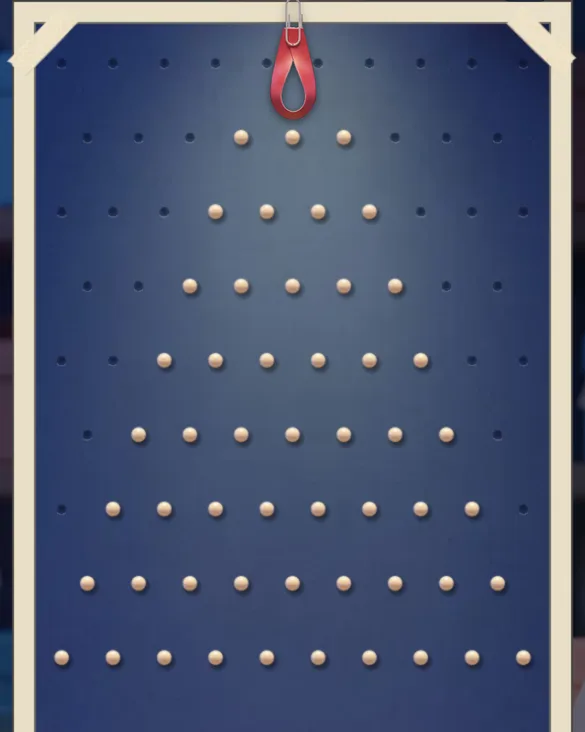
Eight rows
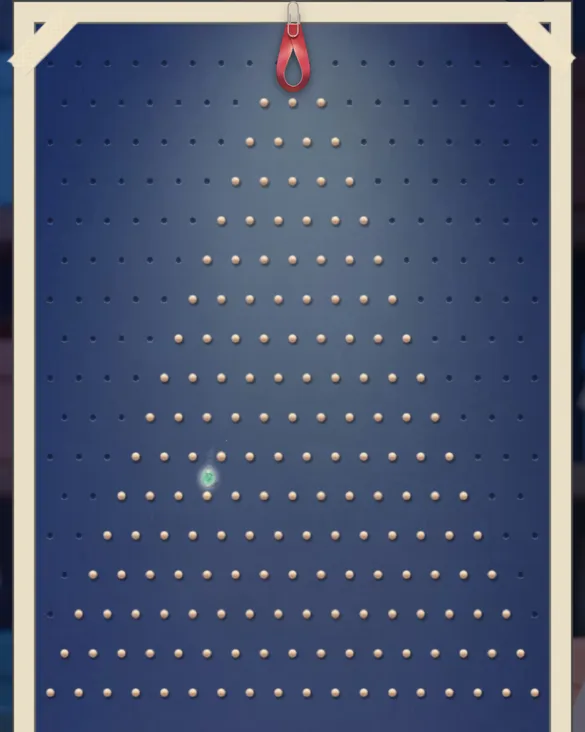
Sixteen rows
So a bigger board is not straightforwardly "better". It buys you a larger possible ceiling in exchange for a lower chance of reaching it and a tighter cluster of small results around the centre. Which of those you want is a question about variance tolerance, not about value.
What risk level changes — and what it doesn't
This is the setting most often misunderstood. Risk level does not change where the ball is likely to land. The physics of the board are fixed; the binomial distribution is fixed. What changes is the payout attached to each slot.
Raising the risk moves value outward: centre slots pay less, edge slots pay more. Lowering it does the reverse. A well-built plinko game keeps the overall return roughly constant across risk levels and simply redistributes it, so "high risk" means a wider spread of outcomes rather than a better or worse deal.
That is the specific claim worth checking on any plinko game you play. If the stated return changes materially between risk levels, one of them is quietly worse and it is usually the one being promoted.
How to read a plinko game before you play it
- Find the full multiplier table. Not the top number — the whole row, every slot. If it is not published, you cannot evaluate the game and should assume the worst.
- Check whether landing probabilities are shown. They are derivable from the row count, so a game that omits them is choosing to.
- Look for a stated return-to-player figure, and check whether it is claimed per risk level or as a single site-wide number.
- Check whether rounds are verifiable. A commit-reveal scheme lets you re-derive a finished round yourself; without one you are trusting an unaudited draw.
- Treat a missing house edge as a red flag. Every plinko game has one. Games that publish it are not being generous, they are being checkable.
The two plinko games on Gift Club
Gift Club runs two, and they differ in exactly the ways described above rather than in theme or animation.
- Plinko — the standard board, offered in three sizes and three risk levels. The guide publishes every multiplier table it runs on, together with the real landing chance for each slot, so the rarity of the top payout is stated next to the payout itself.
- Plinko Gold — a separate board with its own table, documented the same way, including the reason its return lands where it does rather than exactly on the target the other games are priced from.
Both guides take their numbers from the configuration the servers actually run on, and a build check compares the English tables against the translations so a figure cannot drift in a language nobody on the team reads.
Plinko gambling: the part worth being sober about
Paid plinko is gambling. The house edge is real, it applies to every drop, and no board size, risk level or betting pattern removes it. Specifically:
- There is no strategy that changes your expected return. Each drop is independent. Adjusting the risk level changes the shape of your results, never their average.
- Chasing losses by raising stakes does not work. Doubling after a loss ends at a table limit or an empty balance, both of which arrive sooner than intuition suggests. The martingale simulator shows how soon.
- Past drops tell you nothing. The board has no memory. A run of centre results does not make an edge slot "due".
- Promotions are capped and per-claim. A boost that lifts one payout above its normal return is a marketing cost with a claim limit, not a standing edge.
A free or XP-paying mode is the honest way to learn a board's behaviour, because it lets you watch the distribution assert itself over a few hundred drops without funding the lesson.
Common questions
Which plinko game has the best odds?
The one that publishes its full table and its return figure, whatever those turn out to be. Between two games with published numbers, compare the stated return first and the variance second. Between a published game and an unpublished one, there is nothing to compare.
Does high risk pay more overall?
No. It redistributes the same return into rarer, larger wins and more frequent small losses. If a game's return figure genuinely rises with risk, read that as a warning about the low-risk setting.
What are the odds in plinko?
On a fair board every bounce is a coin toss, so the odds come straight from counting paths. Only one path leads to a particular edge slot, which makes it a 1 in 256 chance on eight rows, 1 in 4,096 on twelve and 1 in 65,536 on sixteen. The centre slot is reached by far more paths: 70 on eight rows and 12,870 on sixteen. That is why most drops end in the middle. A good plinko game prints this probability next to each multiplier; ours does, on the Plinko guide.
Is there a plinko strategy?
Not one that changes your return. You cannot aim the ball, and every drop is independent of the last. What you can choose is the shape of a session: fewer rows and low risk give frequent small results, more rows and high risk give rare large ones. Decide how many drops you will make before you start, and stop there.
Is plinko rigged?
It does not need to be — the house edge already does the work. The question worth asking is narrower: can you verify that the specific round you played was not altered after your bet? A commit-reveal scheme answers that; a trust-us statement does not. See how to verify a provably fair round.
Can I practise plinko without staking Stars?
On Gift Club the mini-games offer a Spark mode that pays experience points instead of Stars, at 1 Spark a drop from the daily streak. It is the same board and the same draw, which makes it a genuine way to watch the distribution rather than a demo tuned to flatter.
Keep reading
- Plinko — full tables and landing odds
- Plinko Gold — the bonus board
- Telegram Games RTP Index — published return figures for every game in the app.
Sources
 Spark round
Try it in Telegram
Open Gift Club, claim your Sparks and play a Spark round before you stake anything.
Play Gift ClubIn-app Stars can't be redeemed or withdrawn. 18+.
Keep reading

When a Gift Club Promotion Pushes RTP Above 100%
RTP above 100%: a Stars boost lifts a box or card's expected return to 102% for 5–15 opens, and the Monday cashback returns 10–20% of a week's net loss. How each deal works.

Telegram Games RTP Index: All 16 Games
Telegram games RTP for all sixteen Gift Club games: eleven priced from a 95% target, where the hand-snapped tables land, and what the market discloses.

95% RTP Telegram Games With No KYC
Mines Tower runs at 95% RTP and Gift Club asks for no ID, no selfie and no bank details. Here's exactly why both are possible — and where each one stops.

How to Verify a Provably Fair Round
Verify a provably fair Telegram game: Gift Club's paid mini-games use HMAC-SHA256 commit-reveal. Re-run any round in the app or your console.