


































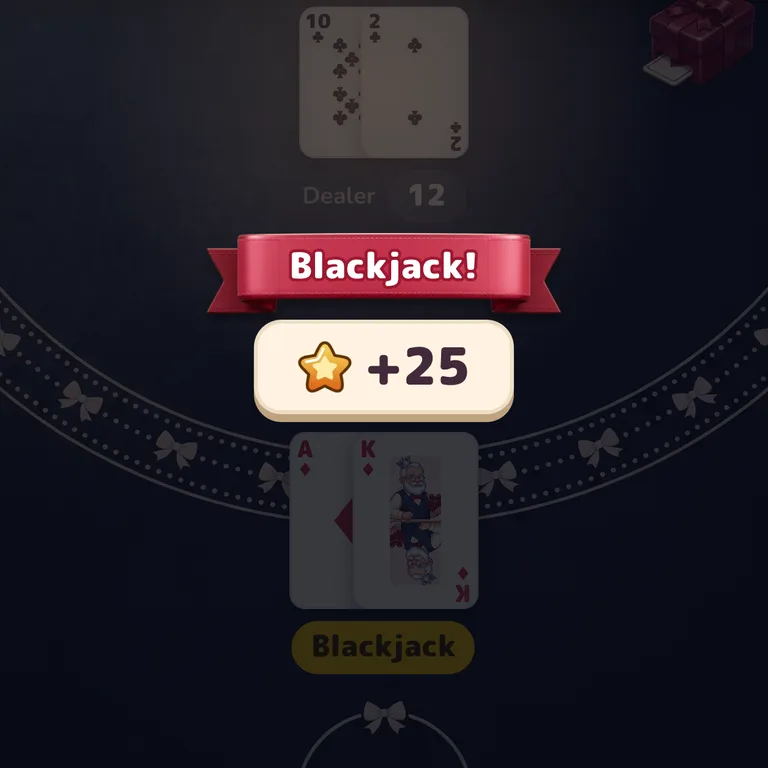
Blackjack's house edge is the share of each first stake the casino keeps over the long run, and it is small: 0.85% on Gift Club's rules, which is a 99.15% return to player (RTP) with perfect basic strategy. It is not 100% because the dealer acts last, and because three rules tilt it further: the dealer hitting soft 17, no double after a split, and doubling on 9 to 11 only. Most players do worse than that figure, with RTPs of 91% to 94%.
Blackjack: play the demo
A free demo of the real game: 10 rounds with demo Stars, no sign-up. Then carry on in Telegram.
Demo Stars are not real Stars and cannot be withdrawn.
Blackjack house edge at a glance
| Question | Answer (12 October 2026) |
|---|---|
| Gift Club rules (3:2, H17, double 9-11, no DAS) | 99.15% RTP, 0.85% house edge, basic strategy (Gift Club simulation) |
| Friendliest rules (3:2, S17, double any two, DAS) | 99.51% RTP |
| Blackjack pays 6:5 instead of 3:2 | 97.79% RTP, 1.36% below the same rules at 3:2 |
| Dealer hits soft 17 | Costs the player about 0.22% (Wizard of Odds) |
| No double after split | Costs the player about 0.14% (Wizard of Odds) |
| Double on hard 9 to 11 only | Costs the player about 0.09% (Wizard of Odds) |
| Casual, never-bust and mimic-the-dealer play | 91% to 94% RTP |
What is the house edge in blackjack?
The house edge is the percentage of your first stake the house keeps on average over a very large number of hands, and RTP is 100% minus it. At 99.15% RTP, the edge is 0.85%: over 1,000 Stars staked on first bets, you expect to lose about 8.5 and get 991.5 back. It says nothing about your next hand, which you win, lose or push like any other. For the idea behind the numbers, see what RTP means and gambling odds explained.
The edge exists because the player must act first. You can bust before the dealer plays, and a bust loses even if the dealer would have busted too. Basic strategy takes most of that back with good choices, which is why blackjack, played perfectly, is one of the lowest-edge games in any casino.
What does blackjack pay, and why does 3:2 vs 6:5 matter?
A blackjack, an ace and a ten-value card on your first two cards, pays 3 to 2 on a standard table, so a 10-Star stake wins 15 Stars. Some tables pay 6 to 5 instead, which wins 12 on the same stake, and that one change takes the RTP from 99.15% to 97.79%, a cost of 1.36% of every first stake. Gift Club pays 3:2.
The 6:5 cost is simple arithmetic: each player blackjack gives up 0.3 of a stake (1.5 minus 1.2). Of all the rules, this one costs the most, and it is the first thing to check at any blackjack table.
Does it matter if the dealer hits soft 17?
Yes: when the dealer hits soft 17, the player loses about 0.22% of the stake, by the Wizard of Odds' rule-variation table. A soft 17 is a 17 counting an ace as 11, such as ace and six. Where the dealer stands on it (S17), that 17 is final. Where the dealer hits it (H17), the dealer can improve to 18 to 21 and sometimes bust, and on balance that favours the house. Gift Club's dealer hits soft 17.
What do doubling and splitting rules cost?
Restrictions on doubling and splitting each cost a small fraction. Gift Club allows a double on a hard 9, 10 or 11 only, instead of on any two cards, which costs about 0.09% by the Wizard of Odds' rule-variation table. It does not allow a double after a split, which costs about 0.14% by the same table. With H17 (about 0.22%) that is 0.45 points, which roughly accounts for the 0.36-point gap between 99.51% and 99.15% in our simulation (the published figures are measured from an eight-deck game). The guide to when to split and double has the charts for these rules.
| Rule set | Basic strategy | Casual play | Never bust | Mimic the dealer |
|---|---|---|---|---|
| A: 3:2, S17, double any two, DAS | 99.51% | 93.02% | 91.90% | 94.35% |
| B (Gift Club): 3:2, H17, double 9-11, no DAS | 99.15% | 94.08% | 92.16% | 93.94% |
| C: 6:5, H17, double 9-11, no DAS | 97.79% | 92.79% | 90.58% | 92.45% |
Each figure is Gift Club's own simulation of 8 million hands per cell, accurate to about 0.08 percentage points, and counted per first stake, the usual blackjack convention. If you count every Star put in on doubles and splits too, Gift Club's table returns 99.23%.
What RTP do real players get?
Players who do not follow basic strategy return 91% to 94%, a house edge of 6% to 9%, whatever the rules. That covers three common styles: a casual player who makes a wrong move about one hand in ten (93.02% to 94.08% in the table), a player who never hits a hand that could bust (91.90% to 92.16%), and one who copies the dealer, hitting to 17 and never doubling or splitting (92.45% to 94.35%). The rules set the ceiling for a perfect player, and habits set where most people land.
Play the numbers yourself
Gift Club is a Telegram mini app with paid games for adults. A round can lose, and every blackjack shoe can be verified afterwards.
Open Gift ClubIn-app Stars can't be redeemed or withdrawn. 18+.
Can you count cards to beat the house edge?
Not here: every hand is dealt from a freshly shuffled six-deck shoe, 312 cards, so nothing carries over from one hand to the next and there is nothing to count. The shuffle is a full Fisher-Yates pass driven by provably fair numbers, and after the hand you can verify the shoe. Counting works only when the same shoe is dealt across many hands, which is why casinos reshuffle with a cut card.
How does blackjack's RTP compare with Gift Club's other games?
Gift Club's paid games are built around a 95% target before promotions (see the Telegram games RTP index), and blackjack's figure depends on the player. Perfect basic strategy returns 99.15%, and the player styles above return 91% to 94%, under that 95% target. A hint in Spark rounds shows the basic-strategy move on tap, so you can learn the moves for free. The blackjack guide has the rules, and the basic strategy chart has the moves.
FAQ
What is the house edge in blackjack?
It depends on the rules and your play. With perfect basic strategy, the edge is about 0.5% on friendly rules (3:2, dealer stands on soft 17, double any two cards, double after split) and 0.85% on Gift Club's rules, which return 99.15%. Most casual players face an edge of 6% to 9%.
What does blackjack pay?
A blackjack pays 3 to 2 on a standard table, so a 10-Star stake wins 15. A 6 to 5 table pays 12 on the same stake and costs the player another 1.36% of each first stake. Gift Club pays 3 to 2.
What is the blackjack RTP?
On Gift Club's rules the RTP is 99.15% with basic strategy, per first stake. The friendliest rule set we tested (dealer stands on soft 17, double any two cards, double after split) gives 99.51%, and 6:5 payouts would give 97.79%.
Is it better if the dealer stands on soft 17?
Yes. A dealer who stands on soft 17 costs the player about 0.22% less than one who hits it, by the Wizard of Odds' rule-variation table. Gift Club's dealer hits soft 17.
Why is the blackjack RTP not 100%?
Because the player acts first and can bust before the dealer plays, and because the rules (the dealer hitting soft 17, no double after a split, doubling on 9 to 11 only) each take a little more. Basic strategy brings the RTP to 99.15% on Gift Club's table, but it cannot reach 100%.
Can card counting help at Gift Club?
No. Each hand uses a freshly shuffled six-deck shoe, so cards seen in earlier hands tell you nothing about the next one.
Sources
- Wizard of Odds: Blackjack House Edge calculator (updated 3 August 2026)
- Wizard of Odds: Blackjack Basic Strategy calculator (updated 3 August 2026)
- Wizard of Odds: Blackjack Basics, effect of rule variations (read 12 October 2026)
- Wikipedia: Blackjack
- Gift Club blackjack simulation, 8 million hands per rule set (12 October 2026)
 Spark round
Try it in Telegram
Open Gift Club, claim your Sparks and play a Spark round before you stake anything.
Play Gift ClubIn-app Stars can't be redeemed or withdrawn. 18+.
Keep reading

RTP Meaning: What Return to Player Is and How It Works
RTP means return to player: the share of stakes a game pays back over the long run. RTP = 1 − house edge, so 96% RTP is a 4% edge. Worked examples inside.
Gambling Odds Explained: House Edge and Expected Value
Gambling odds explained: fractional, decimal and American odds, true odds vs payouts, house edge and expected value, worked on real games.

Telegram Games RTP Index: All 16 Games
Telegram games RTP for all sixteen Gift Club games: eleven priced from a 95% target, where the hand-snapped tables land, and what the market discloses.

Are Slots Rigged? What the Maths Actually Says
Are slots rigged? No — but they are built to keep a margin, and most games never show you the numbers. Here are ours, and how to verify a single spin yourself.