




















"Are slots rigged?" is the wrong question, and that is why it never gets a satisfying answer. A slot machine is designed to keep a slice of every stake — that part is not a secret, it is the business model. The real question is whether the game does what it says it does, and whether you can check. Most slots will not let you. Here is what ours actually does, with the numbers, and how to verify a single spin for yourself.
The short answer
No, a slot at a legitimate operator is not rigged in the sense people mean — it is not watching your balance, it does not know you are on a losing run, and it does not tighten up after you win. It is built to pay back less than it takes, by a margin that is fixed in the maths before anyone plays it.
Both of those things are true at once, and holding them together is the whole point. "Not rigged" does not mean "fair to you". It means the game behaves the same way on your hundredth spin as on your first.
What "rigged" would actually look like
There are three distinct things people have in mind, and they are not equally plausible.
- The game reacts to you. It pays new players more, or tightens after a win, or reads your balance. This is the accusation that gets made most and happens least — it would require per-player state in the outcome path, which is a much bigger engineering commitment than simply setting the paytable lower.
- The published return is a lie. The game claims 96% and returns 88%. This one is plausible wherever nobody checks, which is why licensing regimes exist and why an unlicensed operator's RTP claim is worth nothing.
- The presentation misleads you. Near misses, a bonus round dressed up as generosity, a win celebration for a spin that returned less than the stake. This is legal, common, and the one you should actually worry about.
How slot machines actually work
The outcome comes from a random number generator, and the payout comes from a weighted table. Those are two different things, and conflating them is the source of most of the confusion. The RNG is fair; the weights are where the margin lives.
In our Slots game, each of the 25 cells draws one symbol independently. On High, the default risk level, with these weights:
| Symbol | Weight | Chance per cell | Pays at 7 of a kind |
|---|---|---|---|
| Ruby | 18 | 18.18% | 0.2× |
| Sapphire | 17 | 17.17% | 0.2× |
| Emerald | 16 | 16.16% | 0.4× |
| Topaz | 15 | 15.15% | 0.4× |
| Moon | 10 | 10.1% | 0.8× |
| Thunderbolt | 9 | 9.09% | 1× |
| Laurel crown | 7 | 7.07% | 2× |
| Temple | 5 | 5.05% | 4× |
| Gift (scatter) | 2 | 2.02% | Opens free spins |
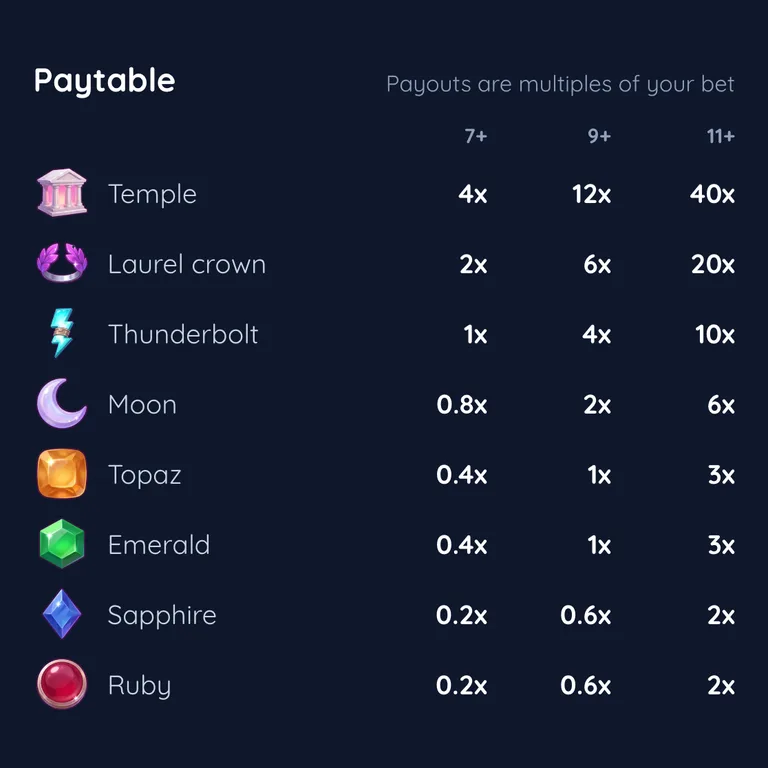
Nothing there is hidden and nothing there is adaptive. The rare symbols pay more precisely because they are rare, and the weights sum to 99 for every player on every High spin. The one thing that changes them is a choice you make yourself: the game has a Low / Medium / High risk selector, and Medium and Low lean the weights towards the cheap symbols, flatten the tumble ladder and shorten the free spins. Each level is a published, frozen, versioned rule set that returns the same 95% and stops at the same 100× — the selector moves the swings, never the margin, and never in response to how you have been doing. The full table, including what each symbol pays at 9 and 11 of a kind, is on the Slots guide — and there is a playable demo at the top of it if you would rather see it than read it.
The number that actually matters, and the one nobody quotes
Our return is 95%, the same at every stake and every risk level: on High, 40 million simulated rounds of the same code that runs the game measure 95.0–95.1%. That is the honest headline: over a very long run, the game keeps about five Stars in every hundred staked.
But an average is a terrible description of what a session feels like. Here is one seeded run of two million spins on High, sorted by what they paid:
| What the spin paid | Share of spins |
|---|---|
| Nothing | 55.81% |
| Less than the stake | 24.96% |
| 1× to 2× the stake | 9.05% |
| 2× to 5× | 6.46% |
| 5× to 20× | 2.98% |
| Over 20× | 0.74% |
Four spins in five either pay nothing or hand back less than you staked. That is not rigging — it is what a 95% return looks like when the payouts are spread the way slot payouts are spread. Any game that pays 100× at the top — and ours does, about once in 8,500 rounds on High — has to lose most of the time to fund it.
The bonus round is where the return hides
This is the single most useful thing to understand about any modern slot, and it is almost never written down.
Of our 95% return on High, about 70 points come from ordinary spins and about 25 points come from free spins — which trigger on 1.35% of spins, about once in 74. So a quarter of everything the game pays back is locked behind an event most sessions never see.
Play a hundred spins and never hit the bonus, and you did not run into a rigged machine. You ran the base game, which on High returns about 70% (Low shifts that to about 83 points from ordinary spins and 12 from free spins, for the same 95%). The advertised figure was always an average over both states, and it is arithmetically impossible for a typical session to feel like it.
When someone says a slot "felt tighter today", this is usually what happened. It is also why comparing operators purely on headline RTP is close to meaningless without knowing how much of it sits behind the bonus.
Near misses: the part that is engineered
On a traditional reel slot, the reel you see is not the reel the maths uses. A physical or virtual reel can be mapped so that the top symbol appears just above or just below the payline far more often than it lands on it. The spin was decided the moment you pressed the button; where the reel stops is a presentation choice, and it can be tuned to show you a near miss.
That is not rigging in the legal sense — the payout is still whatever the RNG decided. It is, however, the clearest case of a slot being designed to feel different from what it is.
Our game does not have that lever, for a structural reason rather than a virtuous one: it pays on the count of symbols anywhere on a 5×5 grid, so there are no reels, no paylines and no stop positions to bias. The rail under the board shows you exactly how many of each symbol landed against the 7 you need. A 6-of-7 near miss is genuinely 6 of 7, and it happens as often as the weights say it should.
How to actually verify a spin
Everything above is a claim. Here is the part that is not: a provably fair game lets you check a finished round rather than trusting the operator's description of it.
- Before the spin, the server generates a secret seed and publishes its SHA-256 hash. The hash commits it to that seed without revealing it.
- You supply a client seed, which you can change whenever you like. The outcome derives from both seeds plus a nonce that counts your spins, so the server cannot pick a result after seeing what you bet.
- Every symbol comes out of that, in one pass — the base grid, every refill, whether the bonus opened and all of the free spins, all fixed before your stake was taken. The round also records which rule set version it was played under, so it is replayed at the risk level you actually chose.
- Afterwards you reveal the seed, check that it hashes to the value published beforehand, and recompute the round.
Our provably fair checker does the recomputation in your browser: paste a revealed server seed, client seed and nonce and it reproduces the round independently. There is a longer walkthrough in how to verify a provably fair round.
The one place this does not apply is the demo on the Slots guide. It runs entirely in your browser off your browser's own random numbers, so there is no server seed and nothing to verify — which is why it hides the fairness shield instead of showing you seeds that prove nothing.
What to check before you trust any slot
- Is the RTP published, and is it specific? "Up to 98%" across a portfolio tells you nothing about the game you are on.
- Can you see the paytable and the symbol frequencies? A paytable without frequencies is half the information — it tells you what a win pays but not how often it comes.
- Can you verify a finished round? Either the operator offers commit-reveal, or a regulator audits it, or you are trusting a claim.
- How much of the return is behind the bonus? If nobody will tell you, assume a lot.
- Is there a free or demo mode with the same maths? A demo tuned to pay better than the real game is the oldest trick there is.
So: are slots rigged?
Not in the way the question assumes. The machine is not out to get you personally, and on a licensed or verifiable game the RNG is doing exactly what it claims. But it is engineered, down to the last weight, to keep a margin and to make the losing spins feel like near things. Those two sentences are the honest answer, and any page that gives you only the first one is selling something.
The useful response is not suspicion, it is arithmetic: know the return, know how much of it sits behind the bonus, know what share of spins pay nothing, and check a round yourself when you can.
Sources

Try it in Telegram
Open Gift Club, claim your Sparks and play a free round before you stake anything.
Play Gift ClubIn-app Stars can't be redeemed or withdrawn. 18+.
Keep reading
How to Win at Slots: The Four Things That Actually Change Your Odds
How to win at slots, answered honestly: nothing changes what a spin pays. Four things change what a session costs — RTP, volatility, stake and when you stop.
Keno Strategy: Best Numbers, Spot Counts and Real Odds
Keno strategy that survives the math: why no numbers beat others, which spot count most often ends a session ahead, and when to stop.
Mines Strategy: What Actually Works in Solo and 1v1 Mines
Is there a mines strategy that works? Real odds on a 5×5 board, why patterns and predictors fail, the rounding edge worth knowing, and new PvP Minefield.
When to Cash Out: The Decision That Changes Everything Except Your Return
Crash and ladder games hand you one decision over and over. On a fairly built ladder every stopping point is worth the same — so what are you actually choosing, and when does the choice start to matter?