

































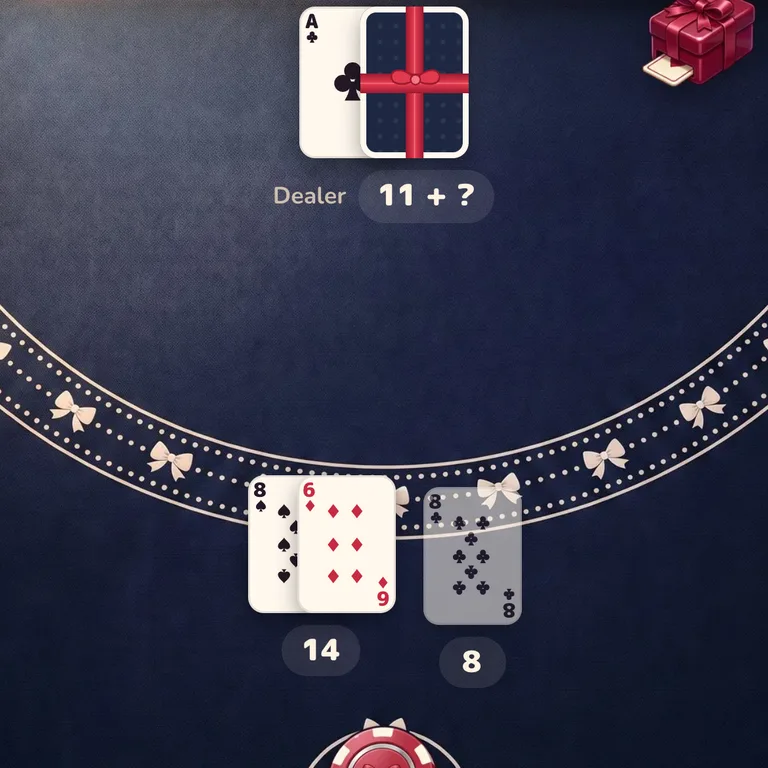
Always split aces and eights, and never split tens or fives. Double down on 11 and 10 when the dealer shows a weak or middling card. Every other pair and double depends on the dealer's up-card, and the tables below answer them card by card. Gift Club's table does not allow a double after a split, so it uses the no-DAS split chart.
Blackjack: play the demo
A free demo of the real game: 10 rounds with demo Stars, no sign-up. Then carry on in Telegram.
Demo Stars are not real Stars and cannot be withdrawn.
When to split and double: the short version
| Hand | Move (checked 12 October 2026) |
|---|---|
| A-A, 8-8 | Always split, against any dealer card |
| 10-10, 5-5 | Never split. Stand on 20; double a pair of fives as hard 10 |
| 9-9 | Split against 2 to 6, 8 and 9. Stand against 7, 10 and ace |
| 7-7 | Split against 2 to 7 |
| 6-6, 3-3, 2-2 | Split against weak cards (the range depends on double after split) |
| 4-4 | Hit. Split only against 5 and 6, and only if you may double after a split |
| Hard 11 / 10 / 9 | Double against 2 to 10 / 2 to 9 / 3 to 6 (and an ace for 11 if the dealer hits soft 17) |
| Strategy source | Wizard of Odds Blackjack Basic Strategy calculator, updated 3 August 2026 |
| Gift Club table | Six decks, dealer hits soft 17, double on hard 9 to 11 only, no double after split, one split |
When should you split in blackjack?
Split when two hands starting on that card beat one hand starting on the pair, which depends on the dealer's up-card. This is the standard chart for four to eight decks where you may double after a split (DAS) and the dealer stands on soft 17, as the Wizard of Odds basic strategy calculator publishes it. A letter means split; a dash means do not split and play the hand as its total.
| Your pair | 2 | 3 | 4 | 5 | 6 | 7 | 8 | 9 | 10 | A |
|---|---|---|---|---|---|---|---|---|---|---|
| A-A | Y | Y | Y | Y | Y | Y | Y | Y | Y | Y |
| 8-8 | Y | Y | Y | Y | Y | Y | Y | Y | Y | Y |
| 9-9 | Y | Y | Y | Y | Y | – | Y | Y | – | – |
| 7-7 | Y | Y | Y | Y | Y | Y | – | – | – | – |
| 6-6 | Y | Y | Y | Y | Y | – | – | – | – | – |
| 3-3 | Y | Y | Y | Y | Y | Y | – | – | – | – |
| 2-2 | Y | Y | Y | Y | Y | Y | – | – | – | – |
| 4-4 | – | – | – | Y | Y | – | – | – | – | – |
| 5-5 | – | – | – | – | – | – | – | – | – | – |
| 10-10 | – | – | – | – | – | – | – | – | – | – |
The dealer's up-card runs across the top. Split sixes against a 2 to 6 and nothing higher, for example, and split nines everywhere except against a 7, a 10 and an ace.
Why always split aces and eights, and never tens or fives?
Two aces start at a soft 12, which is weak, while one ace starts a hand that makes 21 about 4 times in 13 on its next card (a ten-value card is 4 of every 13). Splitting turns one poor hand into two strong starts. A pair of eights is a hard 16, the worst total in blackjack against any strong dealer card, and an 8 is a decent start: splitting trades one losing hand for two that are each only a little behind.
The same logic stops you splitting tens and fives. Ten-ten is 20, which beats everything but 21, so splitting breaks up a hand that mostly wins. Five-five is a hard 10, one of the best doubling hands in the game, and two hands starting on a 5 are far weaker. Fours are hit instead: a hard 8 does not make a good pair of starts.
When should you double down in blackjack?
Double down when your total is strong enough that one more card helps you more than a free choice to keep drawing, and the dealer's card is weak enough that the extra stake is favourable. The best doubles are hard 11 and hard 10 (a ten-value card makes 21 or 20), then hard 9 against dealer cards that tend to bust. Soft hands double against the weakest cards. With S17 and double on any two cards:
| Hard total | 2 | 3 | 4 | 5 | 6 | 7 | 8 | 9 | 10 | A |
|---|---|---|---|---|---|---|---|---|---|---|
| Hard 11 | D | D | D | D | D | D | D | D | D | – |
| Hard 10 | D | D | D | D | D | D | D | D | – | – |
| Hard 9 | – | D | D | D | D | – | – | – | – | – |
| Hard 8 | – | – | – | – | – | – | – | – | – | – |
| Soft total | 2 | 3 | 4 | 5 | 6 | 7 | 8 | 9 | 10 | A |
|---|---|---|---|---|---|---|---|---|---|---|
| A-2, A-3 | – | – | – | D | D | – | – | – | – | – |
| A-4, A-5 | – | – | D | D | D | – | – | – | – | – |
| A-6 | – | D | D | D | D | – | – | – | – | – |
| A-7 | – | D | D | D | D | – | – | – | – | – |
D means double, a dash means do not. Hard 8 and below are never doubled. If you cannot double a soft hand, hit it, except soft 18 (A-7) and above, which stand.
What changes if the dealer hits soft 17, or you cannot double after a split?
Two rule differences move the charts, and both cost the player a little. If the dealer hits soft 17 (H17), the dealer gets a better chance at 18 to 21, so you also double a hard 11 against an ace, double soft 18 (A-7) against a 2 as well, and double soft 19 (A-8) against a 6. By the Wizard of Odds' rule-variation table, H17 costs the player about 0.22% of the stake over S17 with everything else equal.
If you cannot double after splitting, a split hand loses its best feature, so the weaker pairs are split less often. Twos and threes split only against 4 to 7 (not 2 and 3), sixes split only against 3 to 6, and fours never split. Sevens, eights, nines and aces are unchanged. The no-DAS rule costs about 0.14% of the stake by the same table.
| Your pair | 2 | 3 | 4 | 5 | 6 | 7 | 8 | 9 | 10 | A |
|---|---|---|---|---|---|---|---|---|---|---|
| A-A | Y | Y | Y | Y | Y | Y | Y | Y | Y | Y |
| 8-8 | Y | Y | Y | Y | Y | Y | Y | Y | Y | Y |
| 9-9 | Y | Y | Y | Y | Y | – | Y | Y | – | – |
| 7-7 | Y | Y | Y | Y | Y | Y | – | – | – | – |
| 6-6 | – | Y | Y | Y | Y | – | – | – | – | – |
| 3-3 | – | – | Y | Y | Y | Y | – | – | – | – |
| 2-2 | – | – | Y | Y | Y | Y | – | – | – | – |
| 4-4 | – | – | – | – | – | – | – | – | – | – |
| 5-5 | – | – | – | – | – | – | – | – | – | – |
| 10-10 | – | – | – | – | – | – | – | – | – | – |
How do splits and doubles work on Gift Club's blackjack table?
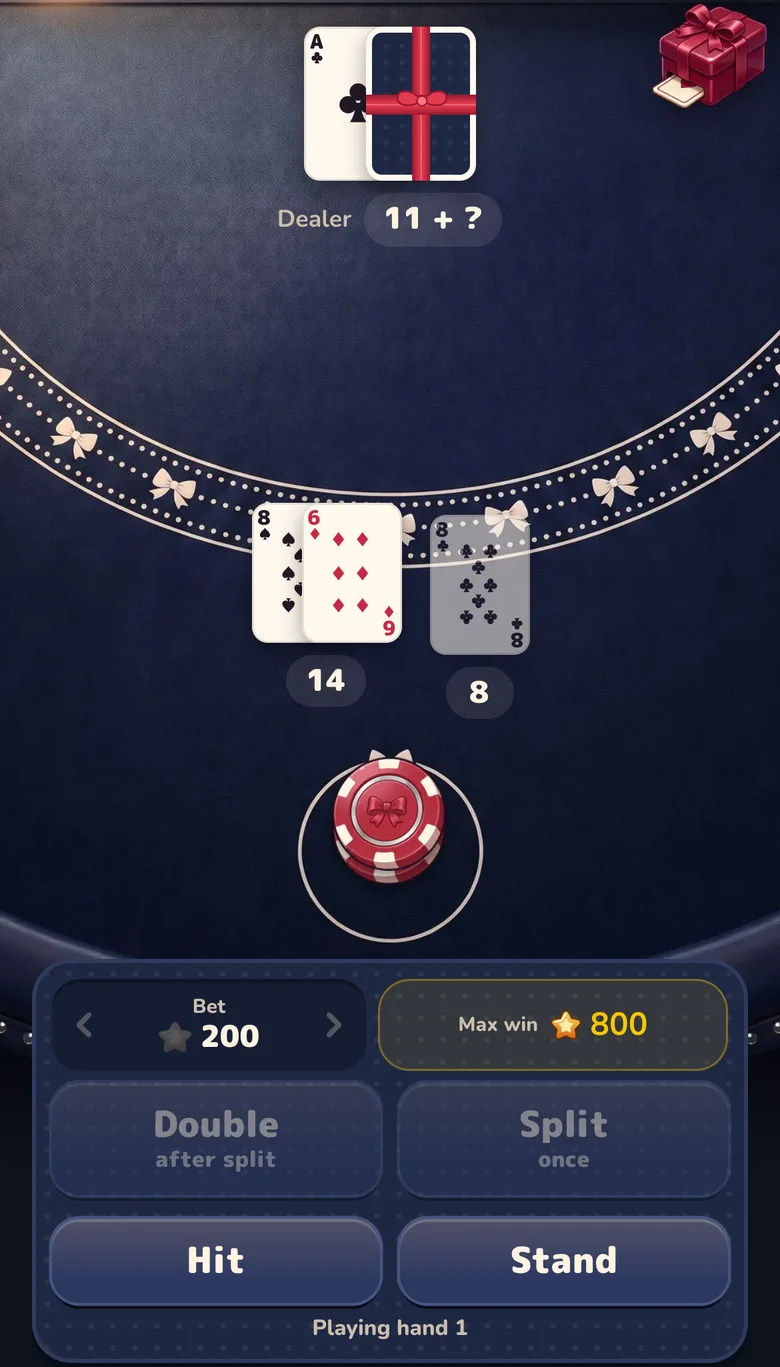
Gift Club's table uses six decks, 3:2 for a blackjack, dealer hits soft 17, double on a hard 9, 10 or 11 only, no double after a split and one split per hand. The dealer checks for blackjack under a ten or an ace, and there is no insurance and no surrender. Its split chart is the no-DAS one above and its double chart is below; they are the moves the game's basic-strategy hint plays, and the hint is on in Spark rounds.
- Split pairs of the same value. Any two ten-value cards (K-Q, for example) count as a pair, but the chart never splits them.
- One split only. If you split eights and draw another eight, you play it as a hard 8 and cannot split again.
- Split aces get one card each. Each ace takes a single card and the hand ends there, so you cannot hit a split ace.
- 21 after a split is just 21. A split ace plus a ten pays 1 to 1, like any other win, not 3 to 2. Only a two-card 21 on an unsplit hand is a blackjack.
- Soft hands are never doubled. The double is for hard 9 to 11, so A-7 against a 6 is a stand and A-2 to A-6 is a hit, where other tables double them.
| Hard total | 2 | 3 | 4 | 5 | 6 | 7 | 8 | 9 | 10 | A |
|---|---|---|---|---|---|---|---|---|---|---|
| Hard 11 | D | D | D | D | D | D | D | D | D | D |
| Hard 10 | D | D | D | D | D | D | D | D | – | – |
| Hard 9 | – | D | D | D | D | – | – | – | – | – |
Hard 11 doubles against every dealer card including the ace, which is the H17 change. A double or a split takes a second stake, so a move your balance cannot cover is refused and the hand carries on with Hit and Stand. For the whole chart, with the hard and soft totals for any rule set, see the blackjack basic strategy chart and hint trainer. To practise the moves for free, play the free blackjack demo.
Practise splits with a hint on
Gift Club is a Telegram mini app with paid games for adults. A round can lose. Blackjack is played on a fresh shoe every hand, and the basic-strategy hint is on in Spark rounds.
Open Gift ClubIn-app Stars can't be redeemed or withdrawn. 18+.
Do these moves still work if the shoe is fresh every hand?
Yes. Basic strategy is built on the cards in play, not on what came before, and on Gift Club's table every hand is a freshly shuffled six-deck shoe, so there is no count to keep. That also means the charts above are exactly right for the odds you face, with no adjustments for cards already seen. Gift Club's blackjack house edge breakdown works out what these rules cost and why basic strategy is worth about 5 to 7 points of return over how most people play.
FAQ
Should you always split aces and eights?
Yes. Against any dealer card, split aces and eights. Two aces make a weak soft 12 and two eights make a hard 16, the worst total against a strong dealer card, while each of the split hands starts from a much better position.
Should you ever split tens?
No. A pair of tens is a 20, which wins most hands, and splitting it throws that hand away for two weaker ones.
Should you split 9s against a 7?
No. Stand on 18 against a 7, 10 or ace. Split nines against 2 to 6, 8 and 9.
When should you double down on 11?
Double hard 11 against a dealer 2 to 10. If the dealer hits soft 17 (as on Gift Club's table), also double it against an ace.
What is double after split (DAS)?
It lets you double down on a hand you made by splitting. It makes splitting 2s, 3s, 4s and 6s better, so charts with DAS split them more often. Gift Club's table does not allow it.
Can you split more than once at Gift Club?
No. Gift Club allows one split per hand, so two hands at most. Split aces take one card each, and a 21 on a split hand pays 1 to 1, not 3 to 2.
Can you double down on a soft hand at Gift Club?
No. Gift Club allows doubling on a hard 9, 10 or 11 only. Soft hands such as A-6 are played as a hit or a stand.
Sources
 Spark round
Try it in Telegram
Open Gift Club, claim your Sparks and play a Spark round before you stake anything.
Play Gift ClubIn-app Stars can't be redeemed or withdrawn. 18+.
Keep reading
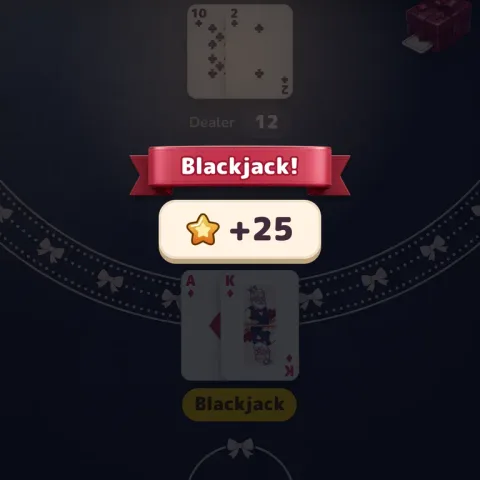
Blackjack House Edge: Why 99.15% Isn't 100%
Blackjack's house edge on Gift Club's rules is 0.85%, a 99.15% RTP with basic strategy. See what 3:2, 6:5, dealer hits soft 17 and no double after split cost.
Yahtzee Rules: How to Play, Scoring and the Yatzy Variant
Yahtzee rules in full: a turn of three rolls, the 13 boxes and their points, the 35-point bonus at 63, a second Yahtzee, and how Scandinavian Yatzy differs.
Ludo Rules and Variants: Mensch, Fia, Petits Chevaux, Kimble
Ludo rules in full: a 6 to start, moving and capturing, blocks, the exact roll home, and how Mensch ärgere dich nicht, Fia and petits chevaux differ.
Chicken Road Review: Is It Legit? vs Wind-up Crossing (2026)
Is Chicken Road legit? Who makes it, where the real demo is, how to spot fake apps and predictor scams, and how it compares with Wind-up Crossing in Telegram.