

































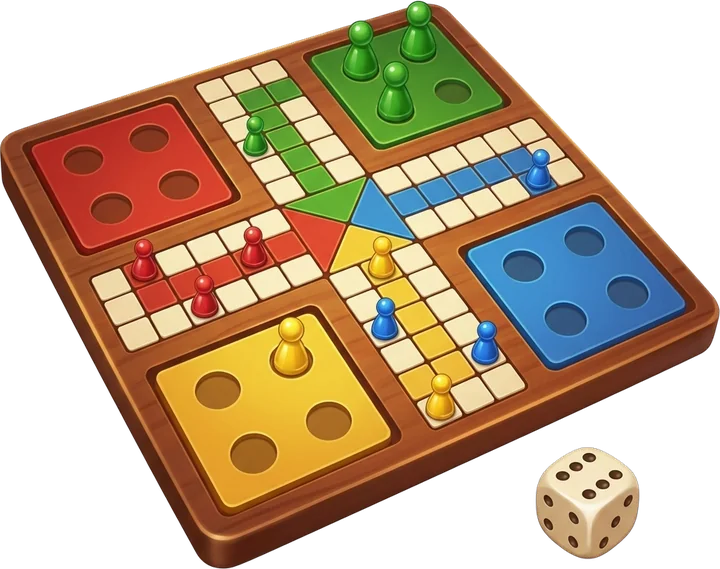
Ludo is a race for two to four players with four pieces each. You need a 6 to bring a piece out of your yard, then move it clockwise round the board by the number rolled and up your own home column; land on another player's piece and it goes back to its yard. The first player to get all four pieces home wins.
Ludo rules at a glance (October 2026)
| Rule | Ludo |
|---|---|
| Players | 2 to 4 |
| Pieces | 4 each, starting in the yard |
| To bring a piece out | Roll a 6 |
| After a 6 | Roll again; a third 6 in a row ends the turn |
| Capture | Land on a single rival piece to send it back to its yard |
| Home column | Usually 5 squares, then the home triangle |
| Finish | Exact roll only |
How do you start a game of Ludo?
Each player puts four pieces in the yard of their colour. Take turns to roll one die. A 6 lets you move a piece out onto your starting square, the coloured square beside your yard, and earns another roll. Roll a 6 three times in a row, though, and your turn ends without a move.
Waiting for a 6 can take a while, so many families give a player up to three rolls while none of their pieces can move. Norwegian Wikipedia records this as the usual rule there.
How do pieces move and capture?
Pieces move clockwise by the number rolled, and one roll moves one piece. If your piece ends its move on a square holding a single piece of another colour, that piece is captured and goes back to its yard, to wait for another 6.
In the most common rules two pieces of one colour on one square form a block. A piece that lands on a block goes back to its own yard instead. Not every family plays blocks, so agree before you start.
How do you get a piece home?
After one lap, a piece turns into its own home column, the coloured lane that leads to the centre. Rival pieces can't enter it, so a piece there is safe. Reaching the home triangle takes the exact number: if the roll is too big, that piece can't move.
Which house rules change Ludo?
Ludo rules vary from family to family. The common house rules:
- Blocks: two pieces of a colour close a square. Some play that a block can't be passed at all.
- Three rolls to start: up to three tries while no piece can move.
- Globes and stars: Danish boards mark globes, where a piece can't be captured, and stars, which send a piece on to the next star (Danish Wikipedia).
- A 1 also comes out: Alga's Ludo for Sweden, Norway and Denmark lets a 1 or a 6 bring a piece out, and a 6 can bring out two.
How do Mensch ärgere dich nicht, Fia and petits chevaux differ?
The same race is played across Europe under other names, each with its own rules:
| Game | Where | Leave the yard on | What is different |
|---|---|---|---|
| Mensch ärgere dich nicht | Germany (Italy: Non t'arrabbiare) | A 6 | Each player starts with one piece on the start square. A 6 must bring a piece out, and the start square must be cleared first. No blocks and no safe squares. Four goal squares, entered by exact count (Schmidt Spiele). |
| Fia med knuff | Sweden | A 1 or a 6 | A 1 puts a piece on the start square; a 6 brings out two, or one straight to the sixth square. You can't pass your own pieces. A roll past the goal bounces back (Alga). |
| Kimble | Finland | A 6 | The die sits in a bubble in the middle of the board and is popped, not thrown. A 6 gives one extra pop (Tactic). |
| Petits chevaux | France | A 6 | A horse must stop exactly in front of its staircase, then climbs it one step a turn on the number of that step, and a 6 takes it into the centre (French Wikipedia). |
| Trouble | United States | A 6 | A pop-up die, as in Kimble. Pegs can't land on their own pegs and are safe in the finish (Hasbro). |
Play Ludo online
You can play all four rule sets now in our free Ludo game: Ludo, Mensch ärgere dich nicht, Fia med knuff and petits chevaux, against one to three computer players, in your browser.
Mensch ärgere Dich nicht is a trademark of Schmidt Spiele, Trouble of Hasbro, and Kimble is published by Tactic. Gift Club is not affiliated with any of them.
Ludo rules: common questions
Do you need a 6 to start in Ludo?
Yes, in the standard rules a piece leaves the yard only on a 6. Some editions, such as Alga's in Scandinavia, also let a 1 bring a piece out.
Do you have to roll the exact number to finish?
Yes. A piece reaches home only on the exact roll; if the number is too big, it stays where it is and you move another piece if you can.
Can two pieces share a square in Ludo?
Two pieces of the same colour can, and in most rules they then form a block. A piece of another colour that lands there goes back to its yard.
What happens if you roll three 6s in a row?
Under the common rule the third 6 ends your turn and you don't move.
Sources
 Spark round
Try it in Telegram
Open Gift Club, claim your Sparks and play a Spark round before you stake anything.
Play Gift ClubIn-app Stars can't be redeemed or withdrawn. 18+.
Keep reading

How to Play Ludo: Rules, Captures and the Six You Waste
How to play Ludo, in full: the rules, the captures, the house rules worth agreeing first, and why a classic board runs forty minutes.
Battleship Rules: How to Play, Ship Sizes and Variants
Battleship rules in full: the 10×10 grid, the five ships and their sizes, placement, calling shots, hit, miss and sunk, winning, and the Salvo variant.

2 Player Ludo: How the Two-Handed Game Really Plays
2 player Ludo is a duel, not a scramble: what changes when one opponent can capture you, and how a short board settles it in about a minute.
Yahtzee Rules: How to Play, Scoring and the Yatzy Variant
Yahtzee rules in full: a turn of three rolls, the 13 boxes and their points, the 35-point bonus at 63, a second Yahtzee, and how Scandinavian Yatzy differs.