





















Keno Strategy: Best Numbers, Spot Counts and Real Odds
Keno strategy that survives the math: why no numbers beat others, which spot count most often ends a session ahead, and when to stop.
Most keno strategy advice is about which numbers to pick. None of it works, and this article shows why in one line of arithmetic. There is a keno strategy that holds up, though. It is about how many spots you mark, how many rounds you play, and when you stop. Those choices do not change the house edge, but they decide what a session feels like and how often it ends with you ahead. Every figure below is computed from the exact paytable of a real game, so you can check each one.
What are the best keno numbers?
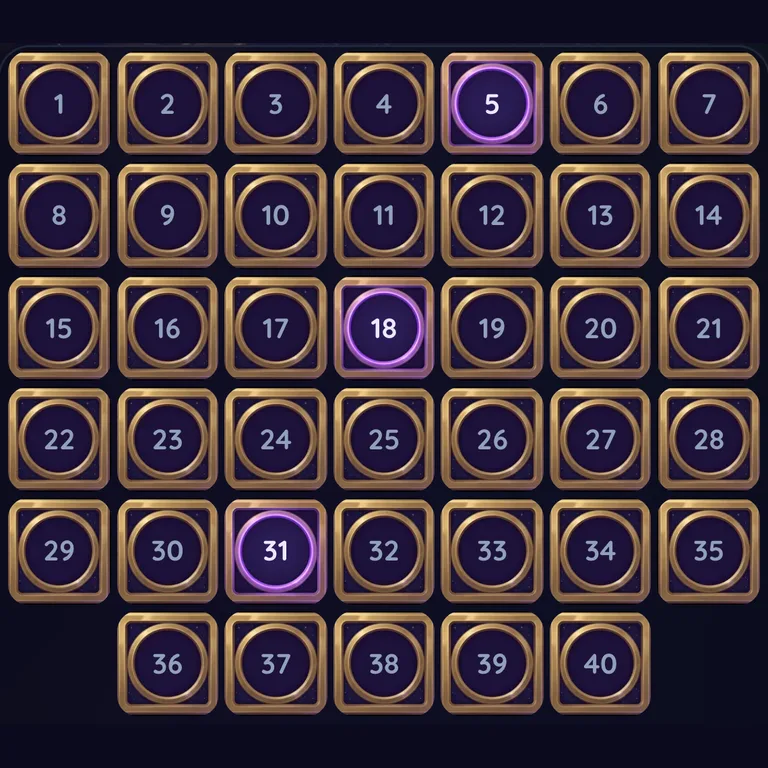
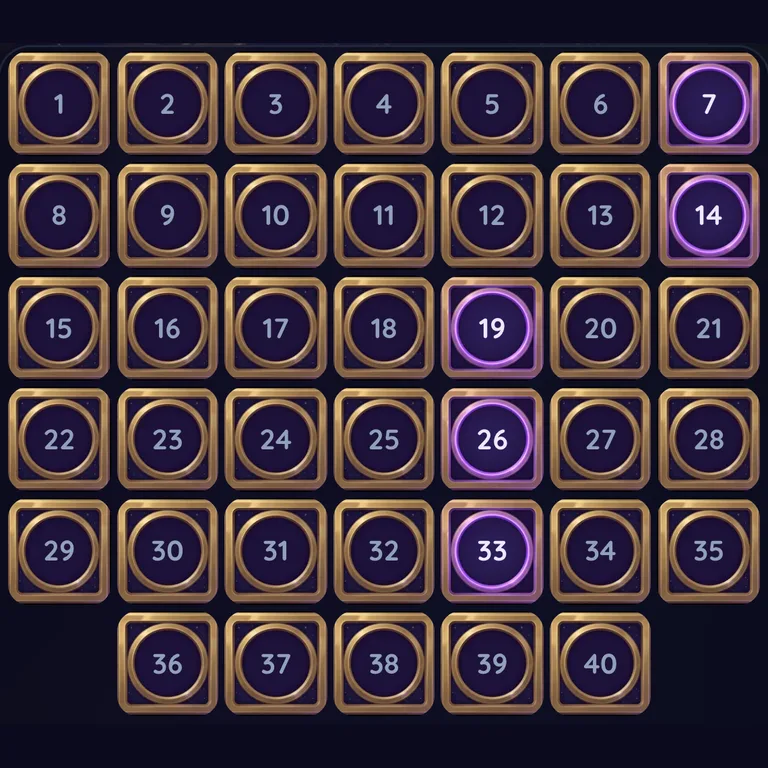
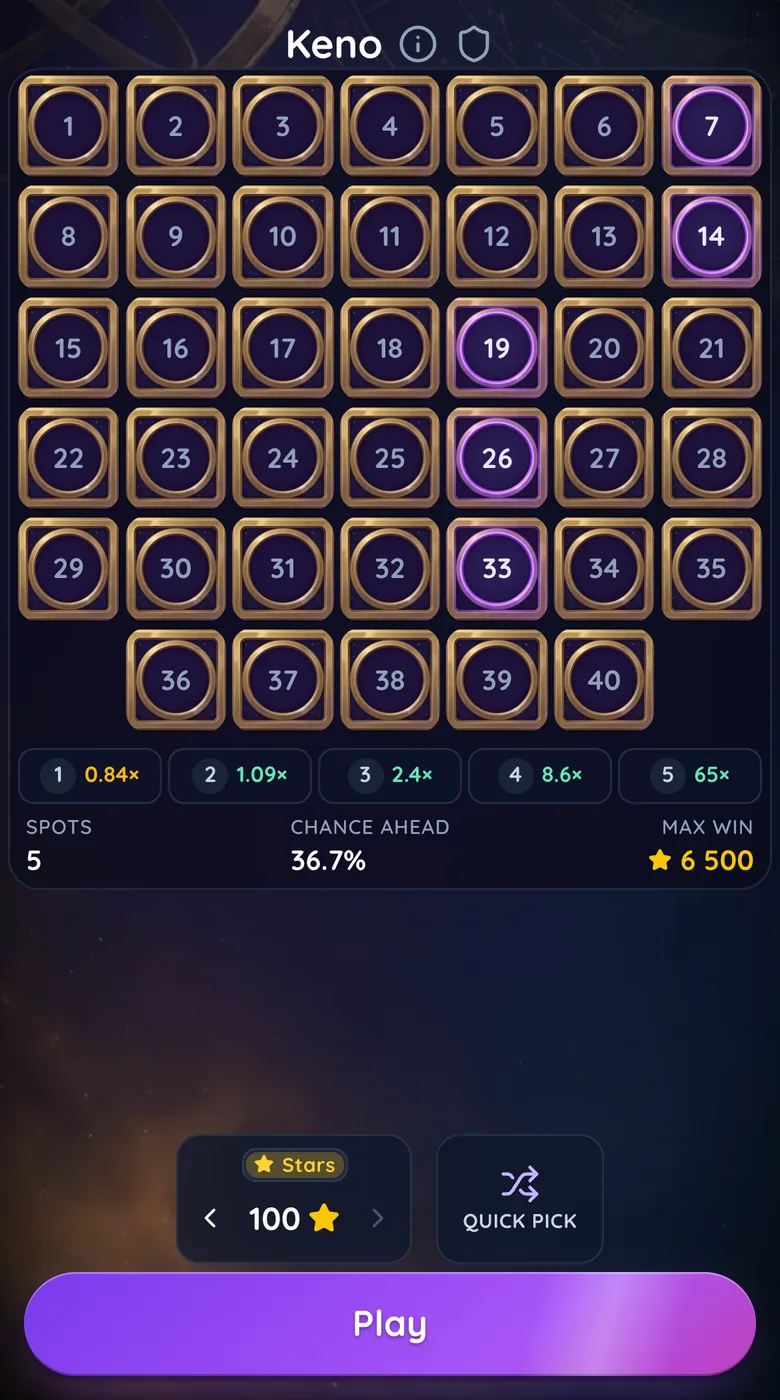
There are none. On our board of 40 tiles, the house draws 10, so every tile has a 25% chance of being drawn in every round. Lottery keno draws 20 from 80, which is also 25% per tile. Your birthday, a diagonal, the four corners and the tile that came up three rounds running all sit at exactly that figure.
"Hot" and "cold" numbers come from reading a real pattern into noise. Over a few dozen draws some tiles will appear far more often than others. That is what randomness looks like over a short run, and it does not carry into the next round. The gambler's fallacy covers why the feeling that a number is "due" is so convincing.
You do not have to take this on trust in our keno. Each paid round is drawn from your server seed, your client seed and a round counter called a nonce, and the nonce goes up by one after every round. Nothing from the previous draw is fed into the next one. Changing your client seed changes which tiles come up, not how likely any of them is. Provably fair verification shows how to check a round yourself.
Does a keno number generator help?
A random-number generator picks sets that are exactly as good as the ones you pick by hand, and no better. It is a fine way to save time. It is not an edge, and an app selling "predicted" keno numbers is selling nothing.
The strategy that works on any keno game: read the paytable
This is the one tip that changes your expected return, and it only works on someone else's game. Many keno games tune each spot count to a different return, and they rarely say so. The counts with the most eye-catching top prize are often the worst value. If a game publishes its return per spot count, play the highest one. If it publishes a single figure with no breakdown, assume some counts pay less than that figure. If it publishes nothing, assume the worst. Casino keno has historically carried house edges several times heavier than most table games.
On Gift Club keno this step is already done for you. Every spot count, from one to five, is tuned to 95%. So on our game, and on any game built the same way, the spot count is not a value decision. It is a decision about volatility.
One round: what each spot count gives you
Same return, very different rounds. The how to play keno guide walks through why. Here is the summary, from the paytable the game actually uses:
| Spots | Pays something | Pays more than the stake | Top prize | Top prize odds |
|---|---|---|---|---|
| 1 | 25% | 25% | 3.80× | 1 in 4 |
| 2 | 44.23% | 44.23% | 5.40× | 1 in 17 |
| 3 | 58.91% | 58.91% | 10.50× | 1 in 82 |
| 4 | 70.01% | 25.59% | 24× | 1 in 435 |
| 5 | 78.34% | 36.69% | 65× | 1 in 2,611 |
The gap between the second and third columns at four and five spots is the bottom rung. One hit pays 0.93× at four spots and 0.84× at five. The round counts as a win on the screen, but you get back less than you staked. Two hits at five spots pay 1.09×, which clears the stake by very little.
A session: the table most keno tips leave out
Nobody plays one round. What matters is where you are after a sitting. The table below is the exact chance of finishing ahead, with more paid out than you staked, after a given number of rounds at a flat stake. It is not a simulation. It is the full probability distribution for each session length, worked out from the paytable.
| Spots | 10 rounds | 50 rounds | 100 rounds | 200 rounds |
|---|---|---|---|---|
| 1 | 47.4% | 36.3% | 35.8% | 33.7% |
| 2 | 40.8% | 37.5% | 35.1% | 29.7% |
| 3 | 35.9% | 35.4% | 33.0% | 28.5% |
| 4 | 31.7% | 28.4% | 28.9% | 27.6% |
| 5 | 28.8% | 27.9% | 23.9% | 20.3% |
Three things stand out, and together they are the strategy.
- Fewer spots end ahead more often. Read down any column and the chance mostly falls. One spot finishes a ten-round session ahead almost half the time. Five spots does so less than three times in ten. Five spots pays something in most rounds, but much of its return is stored in a 65× prize that most sessions never reach.
- Shorter sessions end ahead more often. Read any row from left to right and the chance falls, with one small wobble at four spots. The 5% edge is small per round, and it adds up the longer you play. Your chance of walking away ahead is set mostly by when you walk away.
- Five spots is the only way to win big, and the worst way to win at all. If what you want is a real shot at a large multiple, that is a fair reason to pick it. Just know it is the most expensive spot count in terms of how often a session goes your way.
How far a 100-round session typically swings
The middle 80% of 100-round sessions, in stakes, from a bad session to a good one:
| Spots | Bad session | Typical result | Good session |
|---|---|---|---|
| 1 | −24.00 | −5.00 | +17.80 |
| 2 | −21.96 | −5.36 | +12.52 |
| 3 | −21.29 | −6.05 | +12.62 |
| 4 | −20.12 | −7.72 | +14.58 |
| 5 | −18.99 | −7.78 | +8.13 |
Read the rows as a trade. One spot has the widest swings in both directions. Five spots loses the most slowly on a bad night, because it keeps handing back small amounts, but its good nights are the smallest. The rare 65× hit sits outside this range, beyond the good session. At a 5-Star stake, figures are settled to whole Stars, so a single small payout can land a Star either side. Over a session that evens out.
Keno tips that follow from the numbers
- Choose the spot count by what you want out of the session. Best chance of leaving ahead: one or two spots. Steadiest trickle of small payouts: four or five. A real shot at a big multiple: five.
- Decide the number of rounds before you start. It is the strongest lever on the session table. Write it down if you have to.
- Set a stake you could lose 25 times over. A bad 100-round session at one spot runs about 24 stakes down. Pick the stake from the amount you are comfortable losing, not from the amount you hope to win.
- Stop when you are ahead, if being ahead is the goal. This does not change the expected return. It does lock in the outcome the session table says you will only get about a third of the time.
- Treat the bottom rung at four and five spots as a partial refund. A 0.84× "win" is a loss of 16% of your stake.
Ready to start earning?
Open Gift Club in Telegram and put these methods to work.
Play Gift ClubKeno betting systems that do not work
- Doubling after a loss. Martingale needs an unlimited bankroll and no table limit. At one spot, losing ten rounds in a row happens about once in 18 sessions of ten rounds. Our stakes also come in just five tiers, from 5 to 100 Stars, so the system runs out of room long before it runs out of losses. The martingale simulator shows how quickly with your own numbers.
- Raising the stake after a win. A win does not make the next round more likely to win. It only puts more money on a round with the same odds as the last.
- Waiting for a tile to come up. A tile that has not appeared in twenty rounds still has a 25% chance in the next one.
- Playing several cards to "cover" the board. Each card carries the same return. More cards means more money exposed at that return, not a better one.
- "Six-spot" and other magic counts. These come from casino paytables where one count happens to be tuned better than the rest. That makes it the right choice on that game, for that reason. Read the paytable instead of carrying the rule to a different game.
The short version
No numbers are better than others. Choose a keno game that publishes its return per spot count, and play the best one. On a game where every count returns the same, as ours does at 95%, pick the spot count for the kind of session you want. Fewer spots end ahead more often. More spots swing less but rarely go your way. Then decide how long you are playing and stop there.
To score any other keno paytable, including lottery keno, use the keno odds calculator. The full paytable, with the odds beside every rung, is on the Keno game guide. The RTP index lists the published return for every game we run.
Ready to start earning?
Open Gift Club in Telegram and put these methods to work.
Play Gift ClubSources
Ready to start earning?
Open Gift Club in Telegram and put these methods to work.
Play Gift Club