





















Mines Strategy: What Actually Works in Solo and 1v1 Mines
Is there a mines strategy that works? Real odds on a 5×5 board, why patterns and predictors fail, the rounding edge worth knowing, and new PvP Minefield.
Search for a mines strategy and you will find patterns to tap, predictor bots and videos promising a system. Here is the honest version, worked out on real numbers. On a provably fair board there is no tile-picking strategy at all, one small rounding effect you can actually use, and one decision that matters: when you stop. And with the launch of PvP Minefield, there is now a version of mines where even that decision is gone.
Why no tile pattern can beat mines
In a provably fair mines game the layout is fixed before you tap anything: the server commits to a seed, the seed places the mines, and the round is played against that fixed board. Opening a safe tile only tells you that one tile was safe. Unlike Minesweeper, it shows no number, so it says nothing about its neighbours.
That makes every closed tile exactly equivalent. With 3 mines on 25 tiles the first tap is safe 88.00% of the time — in a corner, in the centre, on the diagonal, in a "pattern" someone swears by. After one safe tile, each of the 24 remaining tiles hides a mine with the same 3-in-24 chance. A strategy built on where to tap is a strategy for something that does not vary.
Mines odds on a 5×5 board
The only thing that sets your odds is how many mines there are and how many tiles you open. The chance of clearing k tiles in a row is the share of layouts in which all k are safe — the same sum any mines calculator does:
| Tiles cleared | 3 mines | 5 mines | 10 mines |
|---|---|---|---|
| 1 | 88.00% | 80.00% | 60.00% |
| 2 | 77.00% | 63.33% | 35.00% |
| 3 | 66.96% | 49.57% | 19.78% |
| 5 | 49.57% | 29.18% | 5.65% |
| 7 | 35.48% | 16.13% | 1.34% |
| 10 | 19.78% | 5.65% | — |
| 12 | 12.43% | 2.42% | — |
| 15 | 5.22% | — | — |
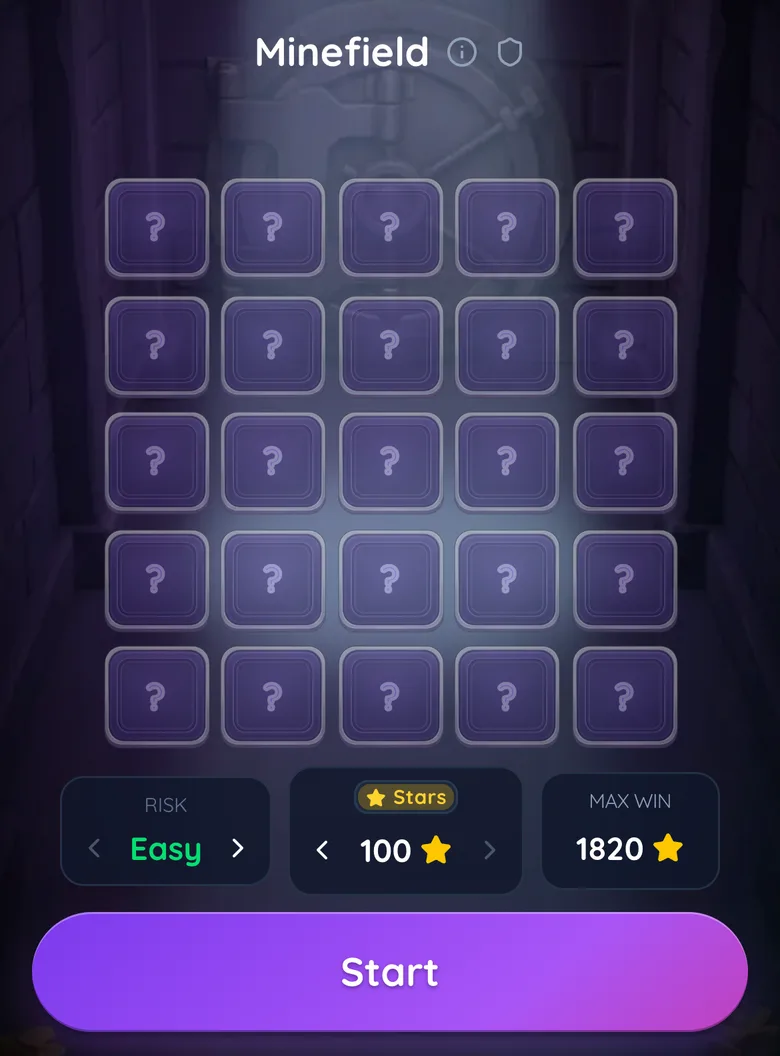
The dashes are the pick limits in our Minefield: 15 picks on 3 mines, 12 on 5 and 7 on 10. Two things stand out. The odds fall much faster than they feel like they should — on 10 mines, three safe tiles in a row happens fewer than one time in five. And the columns coincide in places: clearing 3 tiles on 5 mines is exactly as likely as clearing 5 on 3 mines, 49.57%. For any other board, mine count or house edge, the mines calculator works out every row.
What you actually control: the stop
A fair mines ladder pays each rung at the target return divided by the chance of reaching it. On 10 mines the first tile is safe 60.00% of the time and pays 1.58×; the seventh is reached 1.34% of the time and pays 70.96×. Multiply either pair and you get the same thing: roughly 95% of your stake back on average.
That is the central fact of mines, and every serious mines strategy comes back to it. Cashing out early and pushing for the top rung are worth the same on average. What changes is the spread — early exits win small and often, deep runs lose almost always and occasionally win big. Choosing a stopping point is choosing how bumpy you want the ride, not how much you win. When to cash out works through the same argument on a crash-style ladder.
Ready to start earning?
Open Gift Club in Telegram and put these methods to work.
Play Gift ClubThe one edge you can use: rounding
"Roughly 95%" hides a detail. Multipliers are shown to two decimals and rounded down, so each rung returns a little under the target — and the shallow rungs lose the most, because a hundredth is a bigger slice of a small multiplier.
| Cash out after | Multiplier | Chance of getting there | Return |
|---|---|---|---|
| 1 tile, 3 mines | 1.07× | 88.00% | 94.16% |
| 1 tile, 5 mines | 1.18× | 80.00% | 94.40% |
| 1 tile, 10 mines | 1.58× | 60.00% | 94.80% |
| 2 tiles, 5 mines | 1.50× | 63.33% | 95.00% |
| 7 tiles, 10 mines | 70.96× | 1.34% | 94.99% |
So if you like small, frequent cash-outs, one tile on 3 mines is the most expensive way to do it — 94.16%. Two tiles on 5 mines pays 1.50× on a 63.33% chance and gives back 95.00%. The difference is under a point, and it will not turn a losing game into a winning one. It is also the only rung-level fact in mines that is worth knowing.
Doubling systems, predictors and hacks
- Martingale. Doubling your stake after every loss assumes you can always double and that a win is "due". Neither holds. Each round is a fresh board with no memory, and bet tiers do not double forever: our tiers are 5, 10, 20, 50 and 100 Stars, so a doubling run from 5 has nowhere to go after 20. The martingale simulator plays the system out with your own bankroll and limits. The gambler's fallacy is the belief underneath every system of this kind.
- Mines predictors and signal bots. To predict a provably fair board, a tool would need the server seed before the round is played, and only its hash is published. Anything claiming to know the mines is guessing — or is after your Stars, your account or a "premium" subscription. Telegram Stars scams covers the common versions.
- "Is mines rigged?" The fair answer is to check. After a round the seed is revealed; hash it, compare it with the commitment you were shown, and rebuild the board. Provably fair verification walks through it.
New: PvP Minefield, mines against a person
Gift Club's new PvP Minefield takes the 3-mine board and removes the ladder entirely. Two players share one 5×5 board and take turns opening a tile. A safe tile passes the turn; the first player to open a mine loses, and the other takes both stakes less a 5% rake — 1.90× their own stake, at 5, 10, 20, 50 or 100 Stars, or free for XP.
There is no cash-out and no score, so the one decision solo mines leaves you is gone too. What is left is turn order. Across all 2,300 ways to place three mines, the player who opens first loses 53.13% of the time and the second player 46.87% — whatever tiles either of them picks. A seeded draw decides who goes first, so each player carries that disadvantage half the time and every match is a fair 50/50.
Which makes the PvP Minefield strategy short:
- Tap quickly. Each turn has a 10-second clock. Miss it and a random tile is opened for you — no worse than one you picked, but it takes the moment out of your hands.
- Ignore patterns. The odds on your pick are the mines left divided by the tiles left, whichever tile you choose.
- Pick the stake, not the tile. Winning half your matches returns 95% of what you staked — the same margin as solo mines, taken from the pot rather than the payout table.
- Play people you want to play. Matches start from a challenge link you send in Telegram, or against a bot labelled as a bot. There is no queue of strangers.
If you want a duel where skill does move the needle, PvP Ludo hands you two dice a roll and makes you choose one.
A mines strategy worth having
- Decide your budget before the first round, not after a loss. At a 95% return, the longer you play, the closer your result drifts to losing 5% of everything you stake.
- Choose variance on purpose. Few mines and early cash-outs for a steady session; many mines and deep runs for a rare big hit. Both cost the same on average.
- Skip the one-tile cash-out on 3 mines. It is the most heavily rounded rung on the board.
- Learn in free mode. The boards are identical and the rounds pay XP instead of Stars.
- Verify, do not trust. A mines game that will not let you check a finished round is asking for faith, not offering fairness.
Ready to start earning?
Open Gift Club in Telegram and put these methods to work.
Play Gift ClubSources
Ready to start earning?
Open Gift Club in Telegram and put these methods to work.
Play Gift Club