





























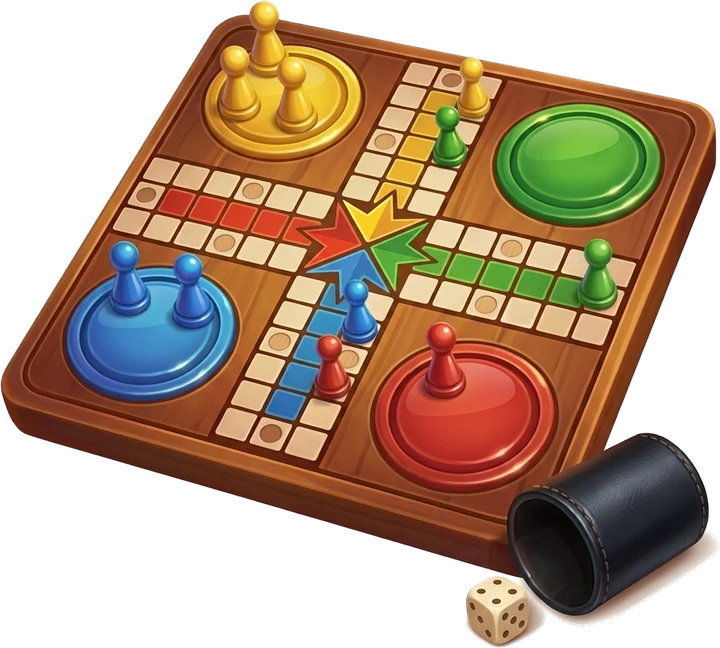
Parchís is the Spanish version of Ludo, for two to four players with four pieces each. You need a 5 to bring a piece out of its jail, then race it counterclockwise round a 68-square track and up your own home column. Capturing a piece sends it back to jail and lets you move 20 squares, and a piece that reaches home lets you move 10. The first player to get all four pieces home wins.
Parchís rules at a glance (October 2026)
| Rule | Parchís |
|---|---|
| Players | 2 to 4, with yellow, blue, red and green |
| Board | A cross-shaped track of 68 squares, four jails and four home columns |
| Pieces | 4 each, starting in jail |
| To leave jail | Roll a 5 |
| After a 6 | Roll again, up to three throws; a 6 counts 7 when no piece is in jail |
| Capture | Land on a lone piece: it goes to jail and you count 20 |
| Reaching home | Exact count only, then count 10 |
How do you start a game of Parchís?
Each player picks a colour and puts four pieces in the jail, the corner of their colour. Everyone throws the die once, and the highest throw starts. Turns pass to the left, and each player throws one die per turn.
A 5 brings a piece out of jail onto the coloured starting square, the salida. Many families make this compulsory whenever you roll a 5 and have a piece in jail. How many pieces leave on the first 5 varies: Spanish Wikipedia notes that some play two pieces out on the first 5 of the game, others always one.
How do pieces move?
Pieces move counterclockwise by the number thrown, one piece per throw, round the numbered squares, then into the coloured corridor of their own colour that leads to the home triangle in the centre. A move is not optional: if the throw lets you do something, you must, and if only one move is possible you make it.
Rolling a 6 gives you another throw, up to three throws in a turn. If a 6 comes up when none of your pieces is in jail, it counts 7. If you roll three 6s, the third sends the piece you last moved back to jail, unless it is already in the home corridor, where it simply stays put.
How do safe squares, barriers and bridges work?
The shaded numbered squares, the seguros, are safe: pieces of different colours can share them and nothing is captured there. The starting squares are safe too.
- Barrier (barrera): two pieces of one colour on one square block the way. No piece can land on a barrier or move past it, and that includes yours. If you hold a barrier and roll a 6, you must open it when you can.
- Bridge (puente): two pieces on one square that are not a barrier, for example two colours on a safe square. Nobody may land on it, but pieces may pass over it.
Rules differ on whether every pair counts as a barrier or only a pair on a starting square, so settle that before you begin.
How does capturing work in Parchís?
If you land on a lone piece of another colour, on a square that is not a safe square, you eat it: it goes back to its jail and you must move one of your pieces 20 squares. Some players count 21. If no piece of yours can use the 20, it is lost.
There is one more capture. If you bring a piece out of jail onto your starting square and rivals are standing there, they are squashed (despachurradas) and go to jail, and you count nothing. With two rival pieces there, the player who leaves jail chooses which one goes back.
How do you get a piece home?
A piece reaches home only on the exact number: if the throw is too big, that piece can't move. Bringing a piece home lets you move 10 squares with another piece. Some play that a piece bounces back from home by the surplus, and some count 11. The first to bring all four pieces home wins, and the others can play on for second and third place.
What changes in Parchís with two dice?
The two-dice version, common online, plays faster. Rules that depended on a 6 now depend on a double, and a 5 can be made as the sum of both dice. Spanish Wikipedia says Exelweiss Entertainment, a Spanish studio, created it in 2004 for the Mundijuegos portal.
How does Parchís differ from Ludo?
| Parchís | Ludo | |
|---|---|---|
| Leave the yard | A 5 | A 6 |
| Bonus for a capture | Count 20 | None |
| Bonus for reaching home | Count 10 | None |
| Barriers | Two pieces block everyone | Blocks in some house rules |
| A 6 | Roll again, counts 7 when jail is empty | Roll again |
See our Ludo rules for the other national versions.
Play Parchís online
Our free Ludo game has a Parchís rule set with the 68-square board, the 5 to leave, the 6 that counts 7, the 20 and 10 bonuses and barriers. You play against one to three computer players in your browser.
Parchís rules: common questions
Do you need a 5 or a 6 to start in Parchís?
A 5. A 6 gives you another throw instead. This is the main difference from Ludo, where a 6 brings a piece out.
What happens if you roll three 6s in a row?
The piece you moved last goes back to jail, unless it is already in its home corridor.
How many squares do you count after capturing?
20, or 21 in some families. Reaching home counts 10, or 11 in some families.
Can you capture on a safe square?
No. Pieces of different colours can share a safe square, and nothing is captured there.
Sources
 Spark round
Try it in Telegram
Open Gift Club, claim your Sparks and play a Spark round before you stake anything.
Play Gift ClubIn-app Stars can't be redeemed or withdrawn. 18+.
Keep reading
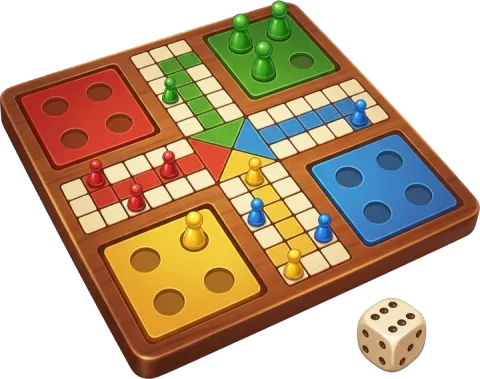
Ludo Rules and Variants: Mensch, Fia, Petits Chevaux, Kimble
Ludo rules in full: a 6 to start, moving and capturing, blocks, the exact roll home, and how Mensch ärgere dich nicht, Fia and petits chevaux differ.
Checkers Rules: How to Play and How Draughts Variants Differ
Checkers rules in full: setup, moves, forced jumps, kings and how to win, then how international, Russian, Brazilian, Spanish, Italian and Turkish differ.
Snakes and Ladders Rules: How to Play and Where It Began
Snakes and ladders rules in full: the 100-square board, how ladders and snakes move you, rolling a 6, the exact finish, the classic board and its Indian origin.
Battleship Rules: How to Play, Ship Sizes and Variants
Battleship rules in full: the 10×10 grid, the five ships and their sizes, placement, calling shots, hit, miss and sunk, winning, and the Salvo variant.