
































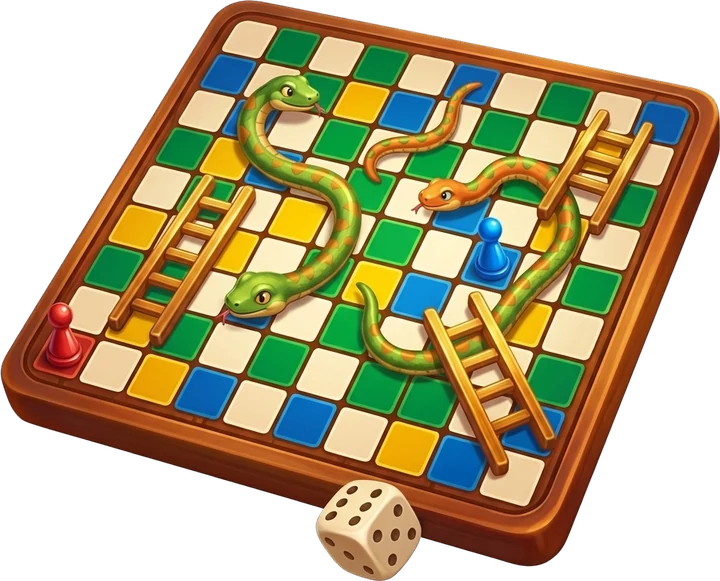
Snakes and ladders is a race game for two or more players on a board of numbered squares, usually 100. Take turns rolling one die and move your token that many squares. If you end on the bottom of a ladder you climb to its top, and if you end on the head of a snake you slide down to its tail. The first player to reach the last square wins. There are no choices, so it is a game of pure luck.
Snakes and ladders rules at a glance (October 2026)
| Rule | Snakes and ladders |
|---|---|
| Players | 2 or more, one token each |
| Board | Usually 10×10 squares, numbered 1 to 100 |
| Dice | One die (two for a shorter game) |
| Ladder | Land on its foot and move up to its top |
| Snake | Land on its head and slide down to its tail |
| After a 6 | Common house rule: roll again |
| Finish | First to reach square 100; some play an exact roll |
How do you play snakes and ladders?
Every player puts a token on the start, the square marked 1 in the bottom left corner or the edge just before it. The squares run back and forth up the board, left to right on the bottom row and right to left on the next, so the track passes through every square once.
On your turn roll the die and move your token forward by that number. If you land on the foot of a ladder, move the token up to the top. If you land on the head of a snake, move it down to the tail. You do not move again after a ladder or a snake, and tokens can share a square. Players take turns until someone reaches the final square.
What happens when you roll a 6?
In the commonly published rules, a player who rolls a 6 moves and then immediately rolls again. Plenty of families play without it, so agree before you start. The Milton Bradley edition does not use a die at all, but a spinner.
Do you need an exact roll to finish?
In the simplest rules the first token to reach or pass square 100 wins. Some versions require the exact number: if the roll is too big, either the token stays where it is, or it moves to 100 and bounces back by the surplus. For example, if you need a 3 and roll a 5, you move forward three and back two.
What is the classic board layout?
The best known board in the United States is Chutes and Ladders, published by Milton Bradley from 1943. The playground-themed edition replaced snakes with chutes, uses a 10×10 board and has 19 ladders and chutes in total. Its layout, which most printed snakes-and-ladders boards copy, is:
| Ladders (up) | Snakes or chutes (down) |
|---|---|
| 1 to 38 | 16 to 6 |
| 4 to 14 | 47 to 26 |
| 9 to 31 | 49 to 11 |
| 21 to 42 | 56 to 53 |
| 28 to 84 | 62 to 19 |
| 36 to 44 | 64 to 60 |
| 51 to 67 | 87 to 24 |
| 71 to 91 | 93 to 73 |
| 80 to 100 | 95 to 75 |
| 98 to 78 |
Other boards put snakes and ladders elsewhere. Their lengths decide how fast a game feels, which is why no two boards play exactly alike.
Where does snakes and ladders come from?
The game began in ancient India as Moksha Patam, a lesson about liberation, and is part of a family of Indian dice games that includes gyan chaupar (the game of wisdom) and pachisi, the game that became Ludo and Parcheesi. Ladders stood for virtues such as generosity, faith and humility, and snakes for vices such as anger and theft. The original had more snakes than ladders, a reminder that the path of good is harder.
It reached England in the 1890s. The earliest known English edition, by F. H. Ayres, was registered in October 1892, and Victorian makers replaced the Indian virtues and vices with English ones. In the United States it became Chutes and Ladders in 1943.
Play snakes and ladders online
Our free Snakes and Ladders game plays the classic board in your browser. If you like a dice race with a little more choice, try our Ludo rules.
Chutes and Ladders is a trademark of Hasbro. Gift Club is not affiliated with Hasbro.
Snakes and ladders rules: common questions
How many squares are on a snakes and ladders board?
Usually 100, in a 10×10 grid. Boards of 8×8 and 12×12 also exist.
Is there any skill in snakes and ladders?
No. Every move is decided by the die, so it is a simple race based on luck, which is why it suits young children.
Do you go down a snake and a ladder in the same turn?
Not in the standard rules: a move ends on the square where a ladder or snake leads, and play passes on.
Why are there fewer ladders than snakes on the old Indian boards?
Sources say it was to remind players that the path of good is harder to climb than the path of vice.
Sources
 Spark round
Try it in Telegram
Open Gift Club, claim your Sparks and play a Spark round before you stake anything.
Play Gift ClubIn-app Stars can't be redeemed or withdrawn. 18+.
Keep reading
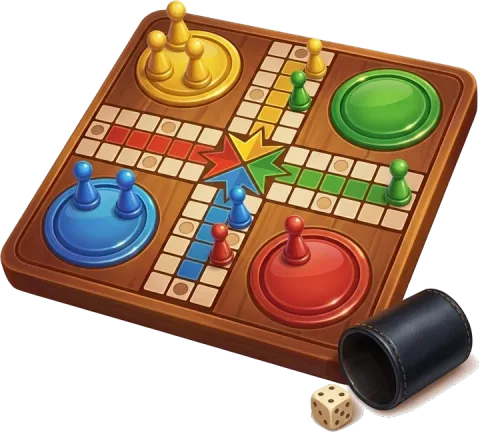
Parchís Rules: How to Play Spain's Version of Ludo
Parchís rules in full: a 5 to leave jail, safe squares, barriers, a 6 counting 7, capturing for 20, reaching home for 10, and the two-dice online version.
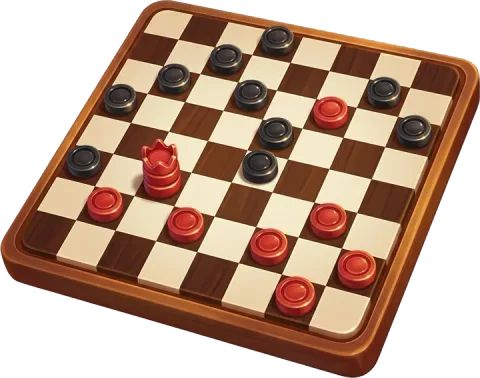
Checkers Rules: How to Play and How Draughts Variants Differ
Checkers rules in full: setup, moves, forced jumps, kings and how to win, then how international, Russian, Brazilian, Spanish, Italian and Turkish differ.
Ludo Rules and Variants: Mensch, Fia, Petits Chevaux, Kimble
Ludo rules in full: a 6 to start, moving and capturing, blocks, the exact roll home, and how Mensch ärgere dich nicht, Fia and petits chevaux differ.
Battleship Rules: How to Play, Ship Sizes and Variants
Battleship rules in full: the 10×10 grid, the five ships and their sizes, placement, calling shots, hit, miss and sunk, winning, and the Salvo variant.