







































No roulette strategy beats the house edge. We ran six popular betting systems, Martingale, Fibonacci, D'Alembert, Labouchère, James Bond and the six-number bet, through 1 million spins each on a single-zero wheel, and every one returned between 97.2% and 97.7% of what it staked, the same 97.30% the wheel pays any bet. What a system does change is the shape of a session: the doubling systems win small most evenings and then lose the whole bankroll at once.
Roulette strategy at a glance
| Question | Answer (18 October 2026) |
|---|---|
| Does any system change the return? | No. All six returned 97.2% to 97.7% over 1 million spins each; the wheel pays 97.30% |
| House edge on a single-zero wheel | 2.70% on every bet (1 in 37) |
| Most often ahead after 100 spins | Fibonacci, 74.7% of sessions, against 37.3% for flat bets |
| Most often bust within 1,000 spins | Labouchère, 96.3% of 100-unit bankrolls, then D'Alembert and Martingale |
| What you lose on average | About 2.70 of every 100 staked, whatever the system |
| What lowers the edge | The wheel and the rules: single zero over double zero, la partage on even money |
Is there a roulette strategy that works?
No betting system can turn a roulette wheel in your favour, because every bet on the table has the same edge built into its payout. A European wheel has 37 pockets, and a bet on one number pays 35 to 1, so 36 units come back for every 37 risked on average. Red pays 1 to 1 on 18 pockets, a six line 5 to 1 on 6: the same 36 in 37, every time. A system only chooses how much goes on which bet and when, and any sum of bets that each return 97.30% returns 97.30%.
What a system can change is how your results are spread. It can make small wins frequent and losses rare and large, or the other way round. That is a real difference to how an evening feels, and it is why progressions look so good in short videos, but it never moves the average. The roulette odds and payouts chart has the edge of every bet on every wheel.
How we tested the systems
We wrote each system as code and played it on a simulated single-zero wheel with classic payouts. Every session starts with 100 units and a 1-unit base bet, and plays up to 1,000 spins, or until the bankroll can no longer cover the smallest bet. Sessions run back to back until each system has played exactly 1,000,000 spins, and every system faces the same sequence of pockets, so the differences between them come from the betting and nothing else. The random numbers come from a fixed seed, so the run can be repeated exactly.
The flat bet, one unit on red every spin, is the control: no system at all. James Bond needs several chips a spin, so we scaled it to 2 units (its classic form is 200). A progression bet larger than what is left becomes an all-in, and there is no table limit, which helps the doubling systems.
Result 1: what each system returned
| System | Average stake per spin | Returned of everything staked |
|---|---|---|
| Flat bet on red (control) | 1.0 units | 97.42% |
| Martingale | 4.1 units | 97.58% |
| Fibonacci | 2.8 units | 97.56% |
| D'Alembert | 8.5 units | 97.44% |
| Labouchère | 14.4 units | 97.63% |
| James Bond | 2.0 units | 97.30% |
| Six line (6 numbers) | 1.0 units | 97.23% |
Every figure sits within a few tenths of a point of 97.30%. The spread is noise: a run of a million spins still swings a little, and the progressions swing more because their stakes are uneven. Run the same systems for longer and they all close in on 97.30%. Nothing in the table is a system beating the wheel.
Result 2: what each system did to a 100-unit bankroll
| System | Ahead after 100 spins | Ahead after 1,000 spins | Bust by 1,000 spins | Median spins lasted |
|---|---|---|---|---|
| Flat bet on red (control) | 37.3% | 18.9% | 1.3% | All 1,000 |
| Martingale | 63.3% | 13.0% | 86.7% | 211 |
| Fibonacci | 74.7% | 25.1% | 74.8% | 399 |
| D'Alembert | 55.3% | 7.4% | 92.5% | 186 |
| Labouchère | 38.3% | 3.7% | 96.3% | 72 |
| James Bond | 35.4% | 10.4% | 20.5% | All 1,000 |
| Six line (6 numbers) | 48.0% | 33.7% | 23.8% | All 1,000 |
This table is where the systems differ. After 100 spins Fibonacci was ahead in 74.7% of sessions and Martingale in 63.3%, far more often than flat betting (37.3%). Play on to 1,000 spins and the same systems had gone bust most of the time: Martingale 86.7%, Fibonacci 74.8%. A 100-unit bankroll on flat 1-unit bets went bust in only 1.3% of sessions, because a flat bettor stakes less, so loses less.
European Roulette: play the demo
A free demo of the real game: 15 spins with demo Stars, no sign-up. Then carry on in Telegram.
Demo Stars are not real Stars and cannot be withdrawn.
Does the Martingale strategy work in roulette?
The Martingale wins often and loses big, and over time it loses the same 2.70% as any bet. You double your bet on red after every loss and go back to one unit after a win, so each win recovers every loss before it plus one unit. In our run it was ahead after 100 spins in 63.3% of sessions, and bust by 1,000 in 86.7%. A 100-unit bankroll lasted a median of 211 spins.
The catch is a losing streak. Six losses in a row cost 1 + 2 + 4 + 8 + 16 + 32 = 63 units, leaving 37 for a seventh bet that should be 64. On red, six losses in a row from any fresh start happen about 1 time in 55, which feels rare but comes round within a few hundred spins. Every progression on this page has the same weakness at a different speed. The Martingale calculator plays it with your own bankroll, base bet and table limit.
What about Fibonacci, D'Alembert and Labouchère?
All three are slower Martingales, and all three went bust more often than flat betting.
- Fibonacci moves one step up the sequence 1, 1, 2, 3, 5, 8, 13… after a loss and two steps back after a win. It climbs more gently than doubling, so it was the system most often ahead after 100 spins (74.7%), and still bust in 74.8% of sessions by 1,000.
- D'Alembert adds one unit after a loss and takes one off after a win. It sounds safe, but on a wheel that loses slightly more than it wins the bet drifts upwards, to an average of 8.5 units a spin in our run, and it went bust in 92.5% of sessions.
- Labouchère writes a line, 1-2-3-4 here, and bets the first plus the last number. A win crosses both off; a loss adds the stake to the end. Finishing a line wins its total, 10 units, but a bad run makes the line, and the bets, grow fast. It staked the most (14.4 units a spin on average), had the shortest median life (72 spins) and went bust most often (96.3%).
The pattern across all four is the same: the more a system raises its bets after losses, the more often it is briefly ahead, and the more surely a long session ends at zero.
Is the James Bond roulette strategy any good?
James Bond is a flat bet split three ways, so it returns 97.30% like everything else. In its classic form you put 140 on 19–36, 50 on the six line 13–18 and 10 on zero, 200 a spin. We played it at 2 units (1.4, 0.5 and 0.1). It wins something on 25 of the 37 pockets, a small profit on every one of them, and loses the whole stake on 1 to 12. That makes for a smooth session until the dozen comes in a few times running: it was ahead after 100 spins in 35.4% of sessions, slightly less often than flat red. It pays the 2.70% edge on 2 units every spin, while spreading them over three bets keeps its swings smaller than 2 units on red would have, so the drift outruns the luck.
What is the 6-number roulette strategy?
The six-number bet is a single six line, six numbers in two rows of the layout, which pays 5 to 1. Flat-betting it returned 97.23% in our run, as close to 97.30% as the rest. It wins less often than red but pays more when it does, so its sessions swing wider. That is why it ended more sessions ahead after 1,000 spins (33.7%) than any other system and also went bust more often than flat red (23.8% against 1.3%). Wider swings, same average.
Do patterns, hot numbers or "due" colours help?
No. Each spin is independent, so a number that has not come up for a while is no more likely on the next spin. On 18 August 1913 black came up 26 times in a row at Monte Carlo, and players who bet that red was due lost fortunes. Every system that waits for a streak before betting against it is the gambler's fallacy dressed as a method. The same goes for sector bets and number patterns on the layout: each pocket is 1 in 37, wherever it sits.
So what is the best roulette strategy?
The best roulette strategy is to choose the game with the smallest edge and to decide in advance how much you will stake in total, because your expected loss is the edge times everything you stake. Four things actually move the numbers:
- Play a single-zero wheel. European roulette has a 2.70% edge; American roulette, with 0 and 00, has 5.26% on almost every bet.
- Look for la partage or en prison. On a single-zero wheel with either rule, even-money bets lose only half the stake on zero, which halves their edge to 1.35%.
- Stake less in total. Losing 2.70 per 100 staked means the system that puts the least on the table loses the least. Progressions raise the total.
- Set a stop before you start. A loss limit and a time limit change nothing about the edge, but they decide how much of it you pay.
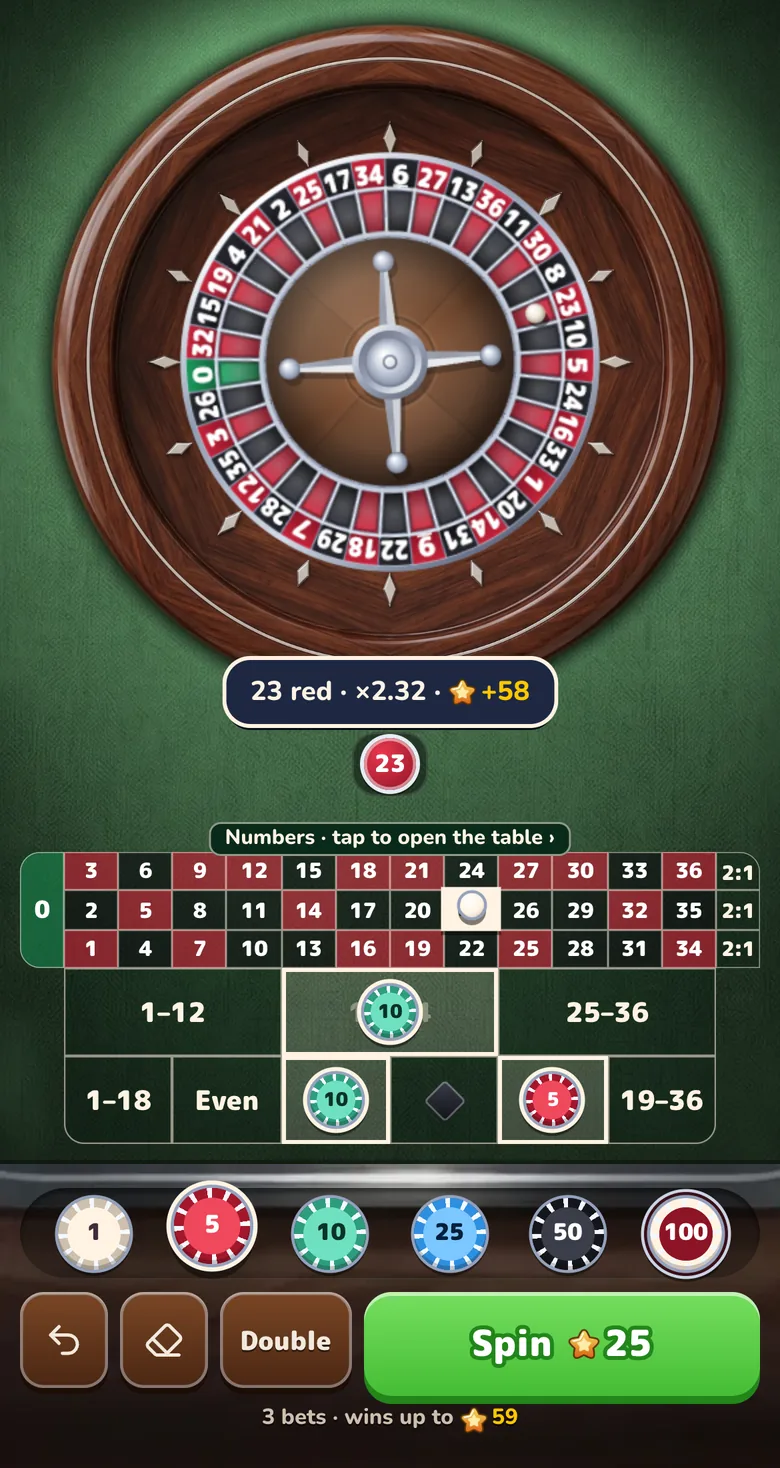
In Gift Club's roulette the bet choice also matters a little, because each bet has its own decimal payout. By its pay table a straight number returns 95.00%, a split 94.97%, a street 94.95%, a corner 94.92%, a six line and the even-money bets 94.86%, and a dozen or column 94.70%. A mix returns the stake-weighted average, so no layout tops 95%. The European roulette guide has the full table and a free demo, and how to play roulette explains every bet on the layout.
Roulette strategy FAQ
What is the best roulette strategy?
No strategy beats the house edge. The best you can do is play a single-zero wheel (2.70% edge, against 5.26% on a double-zero wheel), use la partage or en prison on even-money bets where offered (1.35%), keep your total stake down, and set a loss limit before you start.
Does the Martingale strategy work in roulette?
It wins small amounts often and loses the whole bankroll occasionally. In our simulation of 1 million spins, a 100-unit bankroll doubling on red was ahead after 100 spins in 63.3% of sessions but went bust by 1,000 spins in 86.7%, and it returned 97.58% of everything staked, the wheel's 97.30% plus noise.
Which roulette system loses the least?
Flat betting the smallest stake. Every system returns the same 97.30% on a single-zero wheel, so what you lose is 2.70% of what you stake in total. Progressions such as Martingale, D'Alembert and Labouchère raise the total, so they lose more over a session.
Can you predict where the ball will land?
No. On a fair wheel every spin is independent and each of the 37 pockets has the same chance, 1 in 37, whatever came before. Hot numbers, due colours and patterns are forms of the gambler's fallacy.
Is the James Bond strategy good?
It is a flat bet spread over 19–36, the 13–18 six line and zero. It wins something on 25 of 37 pockets and loses everything on 1–12, and it returns the same 97.30% as any other bet on a single-zero wheel.
What is the RTP of Gift Club roulette?
Between 94.70% and 95% by bet, from its pay table: 95.00% on a single number, 94.97% on a split, 94.95% on a street, 94.92% on a corner, 94.86% on a six line and the even-money bets, and 94.70% on a dozen or column. No system or mix of bets returns more than 95%.
Sources
- Gift Club roulette systems simulation: 1,000,000 spins per system, seed 2026 (18 October 2026)
- Wikipedia: Roulette
- Wikipedia: Martingale (betting system)
- Wikipedia: Gambler's fallacy
 Spark round
Try it in Telegram
Open Gift Club, claim your Sparks and play a Spark round before you stake anything.
Play Gift ClubIn-app Stars can't be redeemed or withdrawn. 18+.
Keep reading

How to Play Roulette: Rules, Bets and Payouts (Free Demo)
How to play roulette in five steps: the rules, every inside and outside bet, what each pays and what happens on zero. Then try it on a free single-zero demo.

Epic Gift Promo Codes for a Free Case — October 2026
What Epic Gift's promo codes give, where it posts them and why a code stops working, plus Gift Club's free boxes on Telegram, with no promo code to type.

Gifts Battle Promo Codes: What They Give — October 2026
What Gifts Battle's promo codes give (mostly a deposit bonus), where it posts them and why a code stops working, plus Gift Club's free boxes on Telegram, with no code to type.

Free Cases Every 4 Hours: Open Spark Boxes in Telegram
Free cases in Telegram: Gift Club's streak pays 20+ Sparks every 4 hours, two free Spark boxes a claim, with Telegram gifts and Stars at the top of the list.