






















How to win at slots has one honest answer and a lot of dishonest ones. The dishonest ones are betting patterns: raise after a loss, switch games after a big win, play at a certain hour. None of them work, and that is not an opinion — a spin does not know what the last spin did. But "nothing works" is wrong too. Four things genuinely change what a session costs you, three of them are decided before you press Spin, and the fourth is the only real decision inside the game.
Why no spin-level system can work
Each spin is drawn independently. In our game that is literally true in the code: 25 cells, each drawing one symbol from a fixed weight table, with no reference to what came before. A provably fair game makes it checkable — the sequence is fixed by a committed seed, so nothing can adapt to your betting.
That kills the whole family of systems at once. A slot that has paid nothing for 40 spins is not "due" — that is the gambler's fallacy, and it is the single most expensive belief in gambling. Nor does raising your stake after a loss recover anything: it changes how much you lose, not how often.
There is also no such thing as a hot or cold machine, no best time to play, and no stop-the-reels timing. If any of those mattered, the outcome would have to be decided after you acted, and in a commit-reveal game it demonstrably is not.
Lever 1: the return, and how much of it is behind the bonus
The return is the only thing that sets your long-run cost, and it is fixed before you arrive. Our Slots game returns 95% at every stake and at every risk level; on High, the default, 40 million simulated rounds measure 95.0–95.1%. At 5 Stars a spin, that is an expected cost of about 0.25 Stars per spin, forever, whatever you do with your stake button.
The part worth comparing between games is not the headline figure but its split. This is High, the level the game opens on:
| Where the return comes from | Share of the stake returned |
|---|---|
| Ordinary spins and their tumbles | About 70% |
| Free spins (trigger once in 74 spins) | About 25% |
| Total | 95% |
On High, a quarter of the return sits behind an event that fires on 1.35% of spins. That is not a flaw, but it is a fact with a consequence: a session that never triggers the bonus is playing a roughly 70% game. If you dislike that shape, the first lever is inside the game — the risk selector under Lever 2 moves part of that quarter back onto ordinary spins — and the second is to play a game with a flatter one: Coin Flip pays 1.90× on a near coin-flip with no bonus at all, and Plinko puts everything in one visible table. Choosing the shape is a real decision. Choosing when to spin is not.
Lever 2: volatility, which you feel and the average hides
Volatility is how widely the outcomes spread around that average. Here is the actual distribution of one seeded run of two million spins of our Slots on High, the default risk level:
| Spin result | Share of spins |
|---|---|
| Paid nothing | 55.81% |
| Paid less than the stake | 24.96% |
| 1× to 2× | 9.05% |
| 2× to 5× | 6.46% |
| 5× to 20× | 2.98% |
| Over 20× | 0.74% |
80.77% of spins hand back less than you put in. That is normal for a game that pays up to 100× the stake, and it is the trade every slot with a big top prize makes: the top prize is funded by the ordinary spins losing.
Volatility does not change your expected loss by a single Star. It changes the chance you are ahead after any particular number of spins, and it changes how big a bankroll you need to survive long enough to be average-ish. A high-variance game with a 95% return and a low-variance game with a 95% return cost the same in the long run and feel nothing alike.
Pick your risk level — the one volatility dial you actually hold
In Stars play our Slots has a Low / Medium / High selector, and it is a real decision rather than a pattern: it changes the variance and leaves the return alone. All three levels return 95% and stop at 100× the stake. Low and Medium pay more of that on ordinary spins, through more frequent small hits, a flatter tumble ladder and shorter free spins.
| Low | Medium | High (default) | |
|---|---|---|---|
| Spins that pay something | 52.6% | 49.5% | 44.2% |
| Ladder top step | 8× | 14× | 20× |
| Free spins per trigger | 5 | 7 | 10 |
| Return from ordinary spins / free spins | About 83 / 12 points | About 78 / 17 points | About 70 / 25 points |
| Median result, 30 rounds at 5 Stars | −22 Stars | −29 Stars | −39 Stars |
| Sessions that finish ahead | 37% | 35% | 33% |
| Worst 10% of sessions | −81 Stars or worse | −89 Stars or worse | −100 Stars or worse |
Those sessions stake 150 Stars each, and the average result is about 7.5 Stars down at every level — the 5% edge, untouched. So be honest with yourself about what the dial buys. Low is for longer, steadier sessions; it is still a slot, and most short sessions on it still lose more than 5%, because the median sits below an average that rare big rounds hold up. High is where the big free-spin rounds live, and where a session without one costs the most. Neither is the smart choice. The pick is remembered, it cannot be changed mid-spin or during free spins, and free rounds always play Low.
Lever 3: stake size — the only dial that moves the money
Expected loss scales linearly with what you stake. Our tiers are 5, 10, 20, 50 and 100 Stars:
| Stake per spin | Expected cost per spin | Expected cost over 100 spins |
|---|---|---|
| 5 Stars | 0.25 Stars | 25 Stars |
| 10 Stars | 0.50 Stars | 50 Stars |
| 20 Stars | 1.00 Stars | 100 Stars |
| 50 Stars | 2.50 Stars | 250 Stars |
| 100 Stars | 5.00 Stars | 500 Stars |
That is the entire arithmetic of stake selection, and it is why every progressive betting system fails. Martingale doubles your stake after each loss to recover it, which works right up until it does not: our tiers stop at 100, so a run of losses walks you off the top of the ladder with nothing to double into. The martingale simulator shows how quickly that happens at any bankroll you like.
The useful version of stake strategy is unglamorous: pick the stake you are content to lose per spin, and leave it there. Spin count times stake times house edge is your expected cost. Nothing else in this article moves that number.
Lever 4: when you stop
This is the one real decision inside a session, and it is not a system for winning — it is a system for not turning a good session into an average one.
Because the return is negative, the longer you play the closer your result converges on losing about 5% of everything staked. Short sessions have wide outcomes; long sessions do not. A win booked and walked away from is the only mechanism by which a negative-expectation game ever hands you a positive result.
This applies far more sharply to games with a cash-out decision — see when to cash out for the maths of ladder games. On slots the only stop that exists is the one where you stop spinning.
What is worth knowing about this game specifically
None of these is a strategy, but they are the things that reward understanding rather than superstition.
- Two symbols can pay on the same grid. They count separately and both clear, which usually sets up a long tumble chain. A cluttered-looking grid is often the one about to run.
- The tumble ladder is where the big numbers come from. On High, 56.79% of base spins produce no win, 23.61% tumble once, 10.82% twice, and 0.10% reach seven tumbles. Because the ladder multiplies — 1×, 2×, 3×, 5×, 8×, 12×, then 20× — that thin tail carries most of the upside. Medium tops out at 14× and Low at 8×.
- The free-spin multiplier never resets. It starts at 1× and adds one per tumble across the whole round, so the late spins carry nearly all of it. On High, with 10 free spins a trigger, the average triggered bonus pays 18.7× the stake.
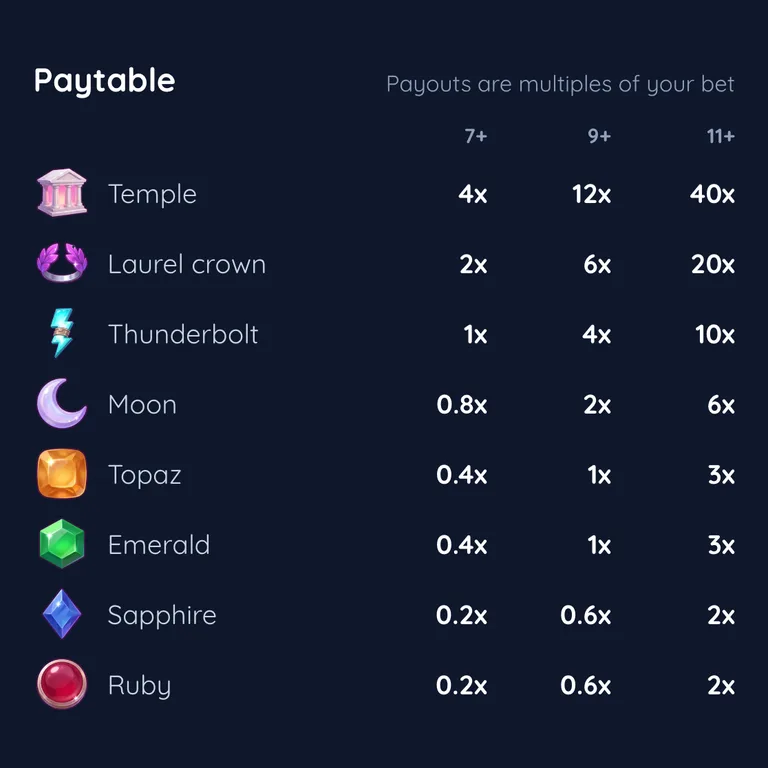
- The rail under the board is real information. It counts every symbol against the 7 you need, so you can see a near miss rather than being shown one.
- The free XP mode uses the same engine, at Low risk. Same grid and same rules, paid in XP, always on the Low rule set. It is the only way to learn how the game moves without paying for the lesson — but High, the default in Stars play, swings harder than what you practised on.
Is there a best time to play slots?
No. This one deserves its own answer because it is asked constantly, in two forms — "when do slots hit?" and "do slots pay more at night?" — and both have the same reply.
An online slot draws each spin independently at the moment you press the button. There is no clock in the outcome path, no per-venue takings target to hit and no day-of-week schedule. On a provably fair game you can go further than taking that on trust: the sequence is committed to a seed before you bet, so a result cannot depend on when you arrived. Playing at 3am costs exactly what playing at 3pm costs.
The grain of truth behind the folklore is that a busy venue has more winners in it, because more spins are happening — not because the machines loosened. Per spin, nothing moved.
Things sold as slots strategy that are not
- Bet patterns and progressions. Martingale, Fibonacci, D'Alembert. They redistribute your losses across time; they do not shrink them.
- "Due" machines and hot streaks. The gambler's fallacy with a costume on.
- Timing the spin, or the hour. The result exists before the animation does, and the clock is not an input to it.
- Predictor bots and hack tools. On a provably fair game these are impossible by construction, since the outcome is committed before the bet. Anything advertising otherwise is selling you something, and usually it is your account.
- Chasing a jackpot near a ceiling. On High our 100× cap is hit about once in 8,500 rounds (227 times in two million simulated spins), and far less often on Medium and Low — and nothing you do makes the next round likelier to be one of them. It is a liability bound, not a target.
The honest summary
So: how do you win at slots? On any single session, by being lucky and stopping. Over many sessions, you do not — the return is below 100% and that is the whole design. What you control is the cost of finding out: which game's return and shape you accept, how much you stake, and how long you keep going. Everything else on offer is a pattern imposed on noise.
If you want to see the distribution rather than read about it, the Slots guide has a playable demo at the top and the full paytable underneath — and you can check any real round with the provably fair checker.
Sources

Try it in Telegram
Open Gift Club, claim your Sparks and play a free round before you stake anything.
Play Gift ClubIn-app Stars can't be redeemed or withdrawn. 18+.
Keep reading

Are Slots Rigged? What the Maths Actually Says
Are slots rigged? No — but they are built to keep a margin, and most games never show you the numbers. Here are ours, and how to verify a single spin yourself.
Keno Strategy: Best Numbers, Spot Counts and Real Odds
Keno strategy that survives the math: why no numbers beat others, which spot count most often ends a session ahead, and when to stop.
New Telegram Games on Gift Club: Keno, Guess the Number and Three Duels
Five additions to the games hub, what each one is actually for, and the odds behind them. A guide to picking between a 65× draw, a search puzzle and three head-to-head formats.
When to Cash Out: The Decision That Changes Everything Except Your Return
Crash and ladder games hand you one decision over and over. On a fairly built ladder every stopping point is worth the same — so what are you actually choosing, and when does the choice start to matter?