

















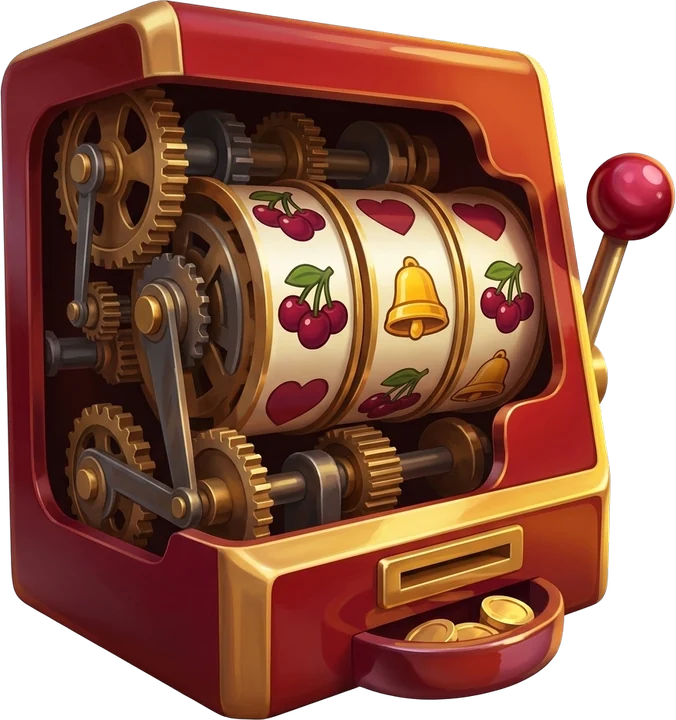
A slot machine works by running a random number generator that picks the result of every spin the moment you press the button, then showing it to you as spinning reels. What you win comes from a fixed paytable, and how much the game pays back over millions of spins is its RTP. The reels, the sounds and the near misses are presentation.
Midnight Panda: play the demo
A free demo of the real game in your browser: 100 spins to start, refilled whenever you run out, no download or sign-up. Then keep playing in Telegram.
Demo spins are free to play with. They cannot be bought or withdrawn.
How a slot machine works at a glance
| Part | What it does (as of November 4, 2026) |
|---|---|
| Random number generator | Picks the outcome of each spin; the spinning is the show |
| Reels and symbols | What you see; on a modern machine they are weighted, not equal |
| Payline | A line across the reels along which a win is counted |
| Paytable | What each winning combination pays |
| RTP | The share of all stakes a game pays back over a very long run |
| Volatility | How bumpy the ride is: many small wins or few big ones |
| Minimum return | Set by law in some places, for example 75% in Nevada |
How does a slot machine decide the result?
It asks a random number generator. Modern machines, online and in a casino, use a program that produces a stream of numbers (usually pseudorandom ones), and each number is mapped to a combination of symbols. The mapping is fixed when you press spin. The reels that turn on screen only reveal a result that already exists.
That is why pressing the button faster, slower or at a lucky moment changes nothing, and why a machine has no memory of your last spin. Each spin is a fresh draw. If you want the longer version of that argument, with a paytable and a way to check a spin, it is in Are slots rigged?
What are reels, symbols and virtual reels?
Reels are the columns of symbols that appear to spin. The first three-reel machine, built by Charles Fey in the late 1800s, had five symbols: horseshoes, diamonds, spades, hearts and a Liberty Bell. Everything was mechanical, so the number of possible results was small.
Electronics changed that. A virtual reel can have many more stops than you can see: three reels with 256 stops each allow 16,777,216 final positions. It also lets the maker weight the symbols. A symbol that shows up once on the visible reel can occupy several stops on the virtual one, and a top symbol can be made much rarer than it looks. The picture is no guide to the chances.
What is a payline?
A payline is a line that crosses one symbol on each reel, and a winning combination is counted along it. Paylines can be straight, diagonal or zigzag, and a game may have one or hundreds. More paylines do not make a slot kinder. They split your stake across more lines and change how often small wins land.
Some newer slots have no paylines at all. They pay for a number of matching symbols anywhere on a grid, which is how Gift Club's slot works (more on that below).
What does RTP mean on a slot?
RTP, return to player, is the share of all the money staked that a game pays back over a very long run. A slot with a 96% RTP keeps about 4 in every 100 staked, spread over millions of spins, and says nothing about your next session. Some places set a floor by law: Wikipedia lists 75% as the minimum in Nevada.
The full explanation, with the worked sum and what a good number looks like, is in What is RTP? You can also watch an RTP settle in the slot RTP simulator.
What is the difference between RTP and volatility?
RTP tells you how much a game pays back in total, and volatility tells you how that money is delivered. Two slots with the same RTP can feel completely different.
| Low volatility | High volatility | |
|---|---|---|
| Wins | Regular, smaller | Fewer, bigger |
| A short session | Smoother | Swings more, can end far from the average |
| Where the RTP sits | Spread across many small wins | Concentrated in rare big ones and bonuses |
That is why an advertised RTP never feels like your own experience: a bonus round can hold a large part of it. How that plays out, and what you can actually control, is in How to win at slots.
What do scatters, wilds and free spins do?
They are rules layered on top of the same random draw. A scatter pays or triggers a bonus wherever it lands, a wild stands in for other symbols, and free spins are extra spins that cost no stake. Some slots also refill the grid after a win, which is called a cascade or tumble. Each has its own page: scatter symbols and cascading reels.
How is Gift Club's slot different from a classic machine?
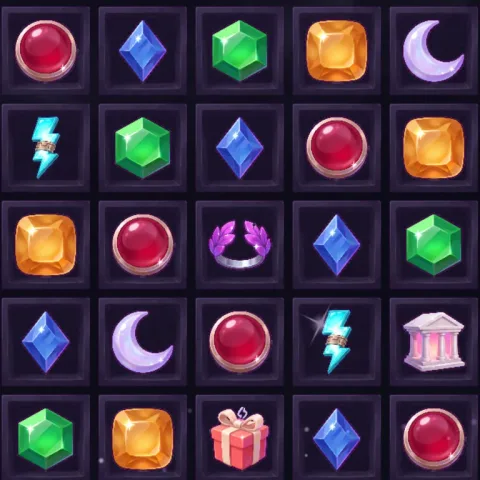
It has no reels and no paylines. The game draws a 5×5 grid, and you win when 7 or more of the same symbol land anywhere on it. Winning symbols clear and new ones fall in, and a special symbol opens free spins. The demo above runs in your browser on your own device's random numbers, so you can watch the mechanics without making an account.
There are four designs on the same math: Gifts of Zeus, Midnight Panda, Neon Mahjong and Candy Chocolatier.
Try how it works yourself, free
The quickest way to understand a slot is to watch a few hundred spins. The demo costs nothing and needs no sign-up. In Gift Club, a Spark round on the slots costs 1 Spark, plays the Low risk level and pays XP, and Sparks are free: the daily streak pays them. Play for the mechanics, not for a result.
Try the game from this article
Watch the mechanics in a real slot
Gift Club has four slot designs on the same maths: Gifts of Zeus, Midnight Panda, Neon Mahjong, Candy Chocolatier. Compare them in the slot machine simulator, or run a long sample in the slot RTP simulator.
How slot machines work FAQ
How do slot machines work?
A random number generator picks the result of each spin when you press the button. The reels you see only reveal that result, and the payout comes from a fixed paytable.
Is every spin on a slot machine independent?
Yes. Each spin is a fresh draw from the random number generator, so the machine has no memory of earlier spins, wins or losses.
What is a payline on a slot?
A payline is a line crossing one symbol on each reel along which a winning combination is counted. Some slots have one, some have hundreds, and some pay for matching symbols anywhere on a grid instead.
What is the difference between RTP and volatility?
RTP is the share of stakes a game pays back over a very long run. Volatility is how that money is delivered: regular smaller wins on a low-volatility slot, fewer and bigger ones on a high-volatility slot.
Are the reels on a slot weighted?
On a modern machine the symbols are usually weighted. A virtual reel can have far more stops than you see, so a symbol that looks common on screen can be rare in the draw.
Can I see how a slot works without paying?
Yes. The demo on this page is a full slot you can play in your browser with no registration. In Gift Club's app, a Spark round costs 1 Spark, and Sparks are free from the daily streak.
Sources
 Spark round
Try it in Telegram
Open Gift Club, claim your Sparks and play a Spark round before you stake anything.
Play Gift ClubIn-app Stars can't be redeemed or withdrawn. 18+.
Keep reading
Are Slots Rigged? What the Maths Actually Says
Are slots rigged? No — but they are built to keep a margin, and most games never show you the numbers. Here are ours, and how to verify a single spin yourself.
How to Win at Slots: The Four Things That Actually Change Your Odds
How to win at slots, answered honestly: nothing changes what a spin pays. Four things change what a session costs — RTP, volatility, stake and when you stop.
Free Slots No Download: Play Instantly in Your Browser
Free slots with no download, no sign-up and no deposit: play four slot designs in your browser now, and learn how to tell a real free game from a casino funnel.
Blackjack House Edge: Why 99.15% Isn't 100%
Blackjack's house edge on Gift Club's rules is 0.85%, a 99.15% RTP with basic strategy. See what 3:2, 6:5, dealer hits soft 17 and no double after split cost.